




25 March 2026 16:45 (UTC)
Getting F1 cars on track for five hours is a seven-day operation. Here’s the full picture of what goes on in the McLaren Mastercard garage during a race weekend

Read time: 9 minutes
Sunday nights are an interesting time in the Formula 1 paddock. It’s a long day, at the end of a long week. By Sunday night, the audience has gone home, and the circus is packing up. For a crew that’s likely been on the ground since Tuesday, and perhaps away from home for multiple weeks, it’s hard, physical work in hi-vis clothing.
Formula 1 race cars have been subbed in for forklifts, but the metaphorical heavy lifting is being done by people on the back end of a long shift… And yet after a good result, it can be a very jolly place: the music – because you need music – is more vibrant and the jokes funnier. Tiredness is banished, the flight cases and cargo boxes seem to load faster, and everyone heads out in a positive frame of mind.
After a difficult result, it can be a tougher experience, but that’s where being part of a good team has the most value: you shake it off together, and everyone lifts each other.
Formula 1 is doubtlessly a data-driven enterprise, but as much as the numbers do matter, it’s people who make the difference. Having a positive atmosphere in the garage, like having a strong dressing room for a football team, is one of the building blocks for success. There isn’t a metric by which it can be tracked – but you know it when you’ve got it.
For those working the race, what is a paddock really like on a race weekend? It’s a part of the sport that doesn’t garner as much attention as what happens out on track, in the pit lane, or even the media pen. It’s a place with its own set of rules and attitudes. We spoke with active and former members of the trackside McLaren Mastercard race team, who shared their stories of what life is really like inside the garage.

“I remember very well my first weekend in the McLaren garage – it struck me as an uber-precise, intense and professional environment, with a rhythmic flow of excellence,” says Jonny Rickett, Manager, Car Support and Infrastructure. “It was Bahrain 2015, and I realised that this place has a relentless pursuit of perfection and, being part of that, I’d now be expected to contribute to it.”
Car support is one of those unsung functions essential for the operation of the garage. In the past, the job title ‘mechanic’ was often misused by onlookers as a generic term for anyone working around a car, but the reality is that mechanics are a small subset of the crew, specifically those who work on the cars.
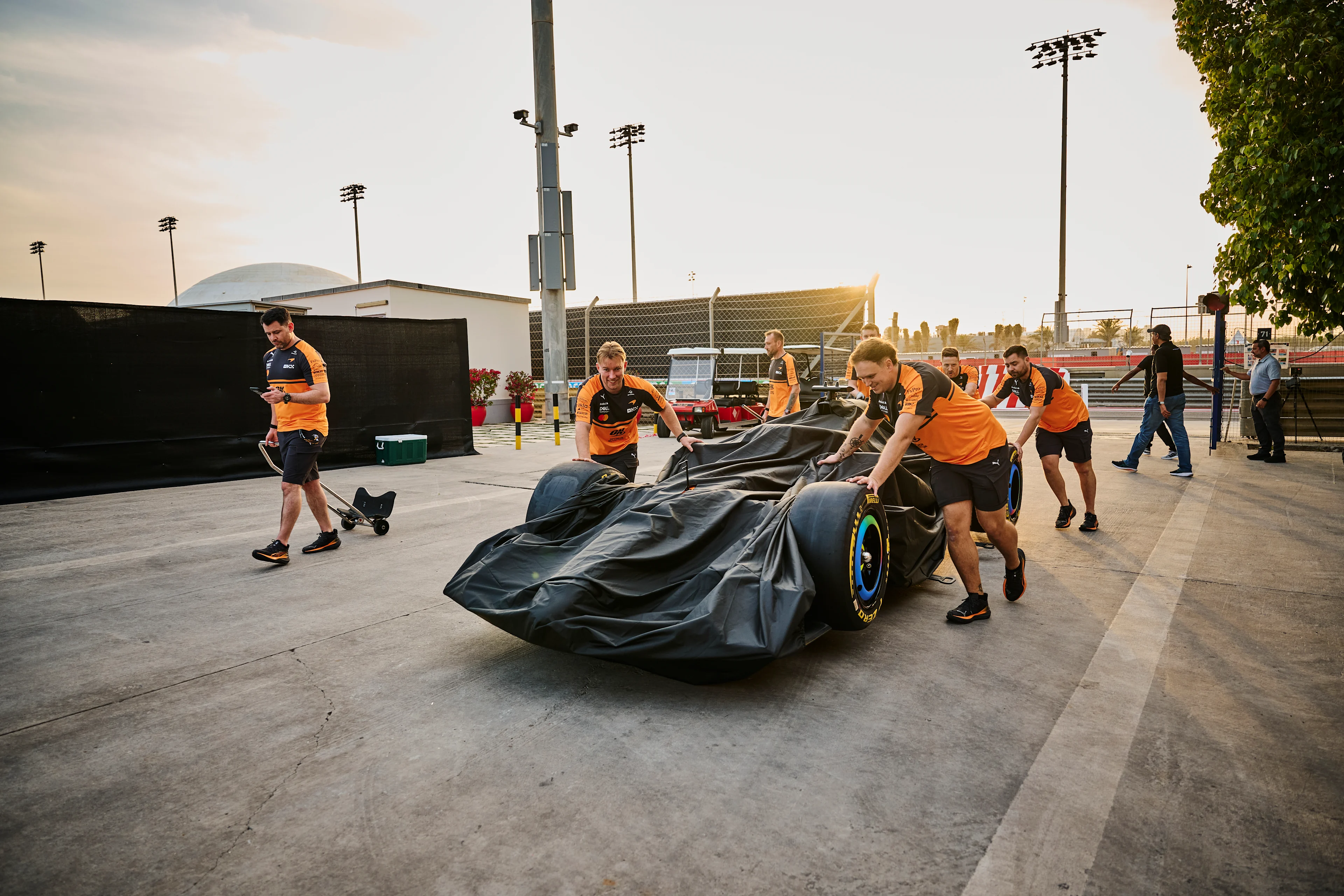
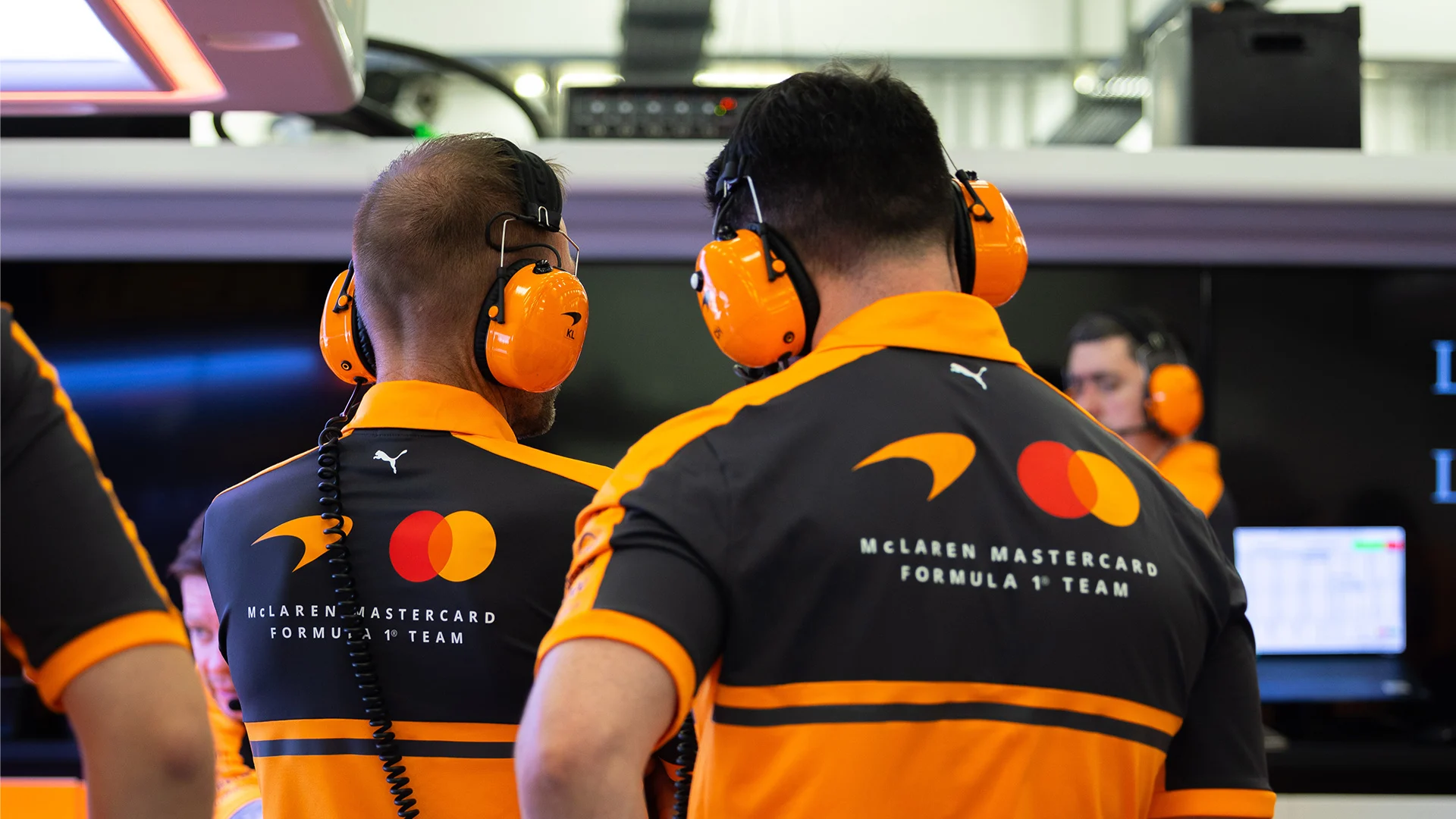
Around them is an army of technicians, building and maintaining bodywork, gearboxes, power units, IT systems and the garage itself. Car Support crosses into a lot of areas, with a cadre of garage techs responsible for everything from hooking the garage into circuit power and air, to building and maintaining the pit gantry. In both the literal and metaphorical sense, they’re the people who keep the lights on.
And it’s a long week – because obviously the mechanics can’t start building the car until there’s a garage in which to build it. The first elements of the support crew might arrive at the track the Saturday or Sunday before the race to begin the task of unpacking freight, installing services and constructing the ‘horseshoe’ – that bit of the garage with the car bays that’s seen on TV.

The nature of the modern calendar is such that the staff who arrive last, won’t see the staff who arrived first, because they’ve already moved on to prepare for the next race. “I’m gone before they arrive - in and out before anyone sees me, like a garage ninja!” says Tom Briggs, Freight Operations Senior Manager.
Tom started at McLaren in 2008, working on the test team support crew, before moving to the race team in 2010. He had a year away with Mercedes in 2015, before returning to McLaren as team leader of the support crew until the end of 2022, when he took up a more factory-based role as Manager, Sea Freight and Infrastructure.
He’ll occasionally be back in the garage for a race weekend to cover for someone as part of the rotation, or simply to pitch in with a strong back and an extra pair of (super-experienced) hands, when there’s a complicated pack-down – Monaco, for example, which is a beast.
“My job is the calm before the storm – and yet in its own way, it’s intense,” says Tom. “Last year, I covered the Qatar race, doing the build as I normally would, but then I stayed on to run the race weekend. The build is a lot more physical: you’re lifting, shifting, and rigging the entire garage so the race team are able to just walk in and start work.”
When working in the garage on a race weekend, you can feel the buzz. “The energy is massive. Huge. Qualifying is when you feel it most,” says Tom. “There aren’t really set-up changes during Qualifying, it’s just fuel and tyres. I used to do tyres, and it’s intense. Set off, set on, pressurise this, re-wrap that - it’s just a blur for an hour – and when you finish, the heart is really going.”

There is a duality about working in the garage. It’s taken incredibly seriously, but it also needs to be fun. There are two types of fun, explains Tom – and he says that working a race weekend is certainly the latter.
“Type one fun is easy: it’s going down to the pub or watching a movie. Type Two fun is when you run a marathon, or you jump out of an aeroplane. When you're doing it at the moment, you're like, ‘oh my god, what am I doing?’ And then afterwards, you're like, 'That was amazing! Do you remember when we did this?”
Andrew Salt has spent his entire career with McLaren, starting as an apprentice, then undertaking eight full seasons as a mechanic in the garage. He’s now back at the factory as Manager, Car Assembly and Hydraulics.
Like most, he worked his way up the ranks through a variety of positions. As an apprentice, he moved between factory departments, learning various roles and the overarching McLaren way of working. Following that, he moved trackside in a support role, where he was charged with “looking after the garage and getting used to being in that environment, seeing how everything works and what the expectations are.” Following his apprenticeship, he became a Number Two mechanic, doing two years on Jenson Button’s car, followed by two on Fernando Alonso’s, before being promoted to Number One.
On TV, you’ll recognise a No.1 as the mechanic standing in front of the car, giving the signal to fire up, unwrap the blankets and ease the car off the jacks, before then walking backwards into the pit lane and ushering the driver out. There’s a little bit of symbolism in this: the car doesn’t leave the garage unless the No.1 says it’s ready to go, and their word is final. Salty had that job for two years with Carlos Sainz and then two more with Daniel Ricciardo.


Like everyone working in the garage, his days followed the clock. “Everything happens to a set deadline, with the whole race week organised around a series of evening curfews. The car is built across Wednesday and Thursday, with the engines and gearboxes being fitted by Wednesday evening, so that when we arrive on Thursday, we can start the car, set it up, and go through all the necessary legal checks.
“The process is very structured,” he adds. “You work through repetition, finding the most efficient way to get things done, buying yourself some leeway if you do encounter problems. When that happens, with the time in hand, you can go back a few steps and fix the issue, so that the car is ready to go out for FP1 on Friday morning without comment.”
The time pressures don’t evaporate once the team gets into the meat of the weekend. It’s particularly noticeable with Sprint weekends, where the team needs to maximise a single practice session – but it’s true for every weekend: start off the weekend on the back foot and you may give up some track time that you can never recover.
“You're always working against the clock – but I enjoyed the pressure: I always found that to be an environment I thrived in,” says Salty. “You’re in a constant state of review, looking at how you might do the same jobs a little better at the next race, be a little more efficient, maybe get a setup change done quicker, and get the car back out on track a minute earlier, buy the driver another lap before the Chequered Flag.”

The garage is a mix of age groups, but the average is lower than that of McLaren as a whole, with many of our longest-serving team members now based at the factory, having previously served lengthy stints as part of the trackside race team. For the majority, 2024 was their first experience of a title fight.
Things were pretty calm going into the season finale, but when Oscar was hit at the first corner, causing him to drop down the order, this put added pressure on the team, as it meant we only had one car that could realistically score us enough points to claim the title.
“Generally, it's a high-pressure environment every single week, but occasionally the pressure goes from high to even higher,” says Jonny. “The one standout moment for me was Abu Dhabi. It was in the balance whether we would win the World Championship or not. Lando drove an amazing race, but we were still fighting with both Ferraris. If something had gone wrong, or we didn’t get the pit stop right, it could have been all over.
“I remember Lando coming to box for that crucial pit stop, and it was… surreal. I was fully focused on what I needed to do. The noise of the car and everything going on around stopped - it felt like there was total silence and that everything was happening in slow motion. We did the stop we needed to do, and the feeling walking back into the garage was great. One of those moments where you need to deliver as a team… and we did.”

The consensus suggested there wasn’t a better way of winning the 2024 Constructors’ title than your team nailing the final pit stop of the year [fastest of the race] to secure a Grand Prix victory. Though it’s harder than they made it look at the end of a long season.
A 10-month F1 campaign takes a toll that is both physical and emotional. In the past, when the seasons drew to a close, energy tended to be at a low ebb. It’s not something that can be prevented, but there are ways to mitigate the impact, which the team now implement as a priority: better pre-season training, recovery protocols, some squad rotation, and better health provisions in the garage.
Mostly, what gets you through, though, is your teammates. In the formal sense, the team has both physical and mental health professionals on site, while many team members are trained as Mental Health First Aiders, with lists of who to talk to posted prominently around the garage, but everyone relies on one another.
“The relationships we have within the team are something we’re proud of,” says Jonny. “There’s a lot of support, a lot of trust and a sense of solidarity. There is pressure, but very little conflict. We’re a tight-knit team and we rely on one another. We’re empowered to share ideas, but also to admit mistakes when things haven't quite gone as planned. We always debrief honestly, and I think the communication within the race team is really open and clear.”
The elephant in the room is, of course, that while we’re one team, the two cars in the garage are often racing against one another – but that’s considered healthy competition, rather than rivalry.
Each side drives the other to be better, while being on hand to help each other out. That might be something as major as helping with an emergency repair, as everyday as prepping bodywork or passing over tools, or as trivial as getting a cup of tea or sweeping the floor. Whatever the task, everyone jumps to it unbidden, knowing they’ll be grateful for the help when the shoe is on the other foot.
“Everyone mixes in the trackside team, and the social side of the garage is very good,” says Salty. “It’s not a case of small groups and cliques sticking to themselves, everyone is more than happy to work together. We’re all in the same boat.
“You’re spending all of that time away from home, and everyone around you is in the best position to understand the difficulties that entails, so you look out for each other. The garage is a good environment to work in.”
And that’s our garage. Very focused and very together, with very high standards. However good the car is, without this, an F1 team doesn’t get anywhere.