



7 March 2023 16:02 (UTC)
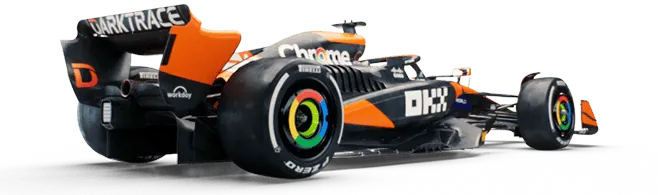
Delve under the skin of our 2020 Formula 1 contender
Want to know more about the new McLaren Formula 1 car? Then look no further...
Monocoque | Carbon fibre composite, incorporating driver controls and fuel cell | |
Safety structures | Cockpit survival cell incorporating impact resistant construction and anti-penetration panels, front impact structure, prescribed side impact structures, integrated rear impact structure, front and rear roll structures, Halo secondary roll structure | |
Bodywork | Carbon fibre composite, including engine cover, sidepods, floor, nose, front wing and rear wing with driver-operated drag reduction system | |
Front suspension | Carbon fibre wishbone and pushrod suspension elements operating inboard torsion bar and damper system | |
Rear suspension | Carbon fibre wishbone and pullrod suspension elements operating inboard torsion bar and damper system | |
Weight | Overall vehicle weight 746kg (including driver, excluding fuel) | |
Weight distribution between 45.4% and 46.4% | ||
Electronics | McLaren Applied. Including chassis control, power unit control, data acquisition, sensors, data analysis and telemetry | |
Instruments | McLaren Applied dashboard | |
Brake system | Akebono brake calipers and master cylinders | |
Akebono ‘brake by wire’ rear brake control system | ||
Carbon discs and pads | ||
Steering | Power-assisted rack and pinion | |
Tyres | Pirelli P Zero | |
Race wheels | Enkei | |
Paint | AkzoNobel Sikkens products | |
Cooling systems | Marelli charge air, engine oil and ERS cooling systems | |
Advanced manufacturing | Stratasys 3D Printing & Additive Manufacturing Mazak Advanced Technology Solutions |
Power unit type | Renault E-Tech 20 | |
Minimum weight | 145 kg | |
Primary PU components | Internal Combustion Engine (ICE) | |
Motor Generator Unit – Kinetic (MGU-K) | ||
Motor Generator Unit – Heat (MGU-H) | ||
Energy Store (ES) | ||
Turbocharger | ||
Control Electronics |
Capacity | 1.6 litres | |
Cylinders | Six | |
Bank angle | 90-degree vee angle | |
No of valves | 24 | |
Max speed | 15,000 rpm | |
Max fuel flow rate | 100 kg/hour (above 10,500 rpm) | |
Fuel consumption | 110 kg ‘lights to flag’ regulated fuel capacity limit | |
Fuel injection | Direct injection, single injector per cylinder, 500 bar max | |
Pressure charging | Single-stage compressor and exhaust turbine, common shaft |
Architecture | Integrated Hybrid energy recovery via Motor Generator Units | |
Crankshaft coupled electrical MGU-K | ||
Turbocharger coupled electrical MGU-H | ||
Energy store | Lithium-Ion battery, between 20 and 25 kg | |
Maximum energy storage, 4 MJ per lap | ||
MGU-K | Maximum speed, 50,000 rpm | |
Maximum power, 120 kW | ||
Maximum energy recovery, 2 MJ per lap | ||
Maximum energy deployment, 4 MJ per lap | ||
MGU-H | Maximum speed >125,000 rpm | |
Maximum power, unlimited | ||
Maximum energy recovery, unlimited | ||
Maximum energy deployment, unlimited |
Gearbox | Carbon fibre composite main case, longitudinally mounted | |
Gear ratios | Eight forward and one reverse | |
Gear selection | Electro-hydraulically operated seamless shift | |
Differential | Epicyclic differential with multi-plate limited slip clutch | |
Clutch | Electro-hydraulically operated, carbon multi-plate |
Transport | Volvo Trucks |
McLaren Plus is our free-to-join fan loyalty programme, bringing McLaren fans closer to the team with the most inclusive, rewarding and open-to-all fan programmes in F1 & esports.
Sign up now, or current members can amend their details in the form below if necessary.