


4 November 2020 18:10 (UTC)
Take a deep dive into the thinking behind our race at Imola

F1’s first (planned) two-day event produced a race of fine margins and big decisions. We take a deep dive into what happened at the Emilia Romagna Grand Prix.
One of the very great challenges of Formula 1 is the way in which it demands constant adaptability. Cars that last weekend effortlessly smashed the lap record on the wide, smooth asphalt of Portimão, this week did the same at narrow bumpy Imola. Across the last two months, F1 has visited three circuits in Italy demanding, respectively, ultra-low drag, maximum downforce and, this week, a nebulous something in between. This very much is part of the appeal – though for engineers and strategists trying to navigate a route through it, it can, at times, feel like playing darts blindfolded.
This week, the extra wrinkle was the compressed timescale of a two-day event. With 14 years and one major track reconfiguration since the last time F1 came here, the paucity of relevant data was compounded by practice being restricted to a single session only, held on Saturday morning. To a certain extent, the layout of the Autodromo Internazionale Enzo e Dino Ferrari came to the aid of strategists: the great difficulty overtaking gave a primacy to track position and made an uninterrupted grand prix a near-certain one-stop affair – but even without the late race Safety Car period, the Emilia Romagna Grand Prix demonstrated how ‘one-stop’ covers a multitude of options, because, as we say, F1 demands adaptability.
Carlos Sainz | Lando Norris | |
Starting position | P10 | P9 |
End of lap one | P10 | P9 |
Finishing position | P7 | P8 |
Speed trap | 300.4km/h (4th) | 289.4km/h (19th) |
First pit-stop | Lap 17: 29.950 (12th quickest of 30) | Lap 13: 29.683 (4th quickest) |
Second pit-stop | Lap 51: 30.614 (24th quickest) | Lap 53: 30.203 (15th quickest) |
Fastest lap | Lap 62: 1:18.118 (11th) | Lap 63: 1:18.069 (8th) |

With no meaningful historic data to work with and just the one session of practice, the ten teams at Imola were all relying heavily on their simulations to provide set-up information. We maximised the 90 minutes on track and ran a split test of all three compounds across the two cars. This provided good data, and confirmed the belief that, given the paucity of overtaking opportunities, this would be a one stop race, with all three strategies in play. In many respects, P9 and P10 weren’t great starting positions. Obviously, P7 and P8 would have been better but – with the benefit of hindsight – P11 and a choice of starting tyre would not have been terrible either.
“We expected it to be a one-stop given the high pit-loss, and we did think cars starting on the Medium tyre would be in a stronger position than those starting on Softs – though that, perhaps, made to look better by one of the cars starting on the Medium (Sergio Pérez) having really good race pace,” says Randy Singh, Head of Strategy and Sporting. “The first part of the race played out as we expected with those on the Soft struggling a bit more than the Medium runners, with people battling to protect track position as a result. You would probably have preferred being 11th on a new Medium than starting 10th on a used Soft – but it’s not clear-cut either way as it has been at other races.”
Both drivers held position at the start and finished the first lap P9 and P10. In the early stint, Lando was running at a comfortable 2s gap to Daniil Kvyat, with Carlos in close proximity. On Lap Six, Carlos launched an attack on his team-mate and took P9 going into the Tamburello. When Pierre Gasly retired on Lap Eight, they moved up to P8 and P9. Pérez gradually started to gain on Lando, and got within DRS range by Lap 10. Lando pitting on Lap 13, swapping to the Medium tyre. Carlos went a little longer, pitting on Lap 17 and also switching to the Medium tyre.
“We saw that other people had already pitted onto the Hard tyre but we chose to fit the Medium because we felt it was the better tyre for the rest of the race,” says Randy. “The Medium was going to be less robust in terms of getting to the flag, – but we were not just looking to get to the end, we also needed to get there as quickly as possible and the Medium had a pace advantage, both in the short-term and over the stint.”
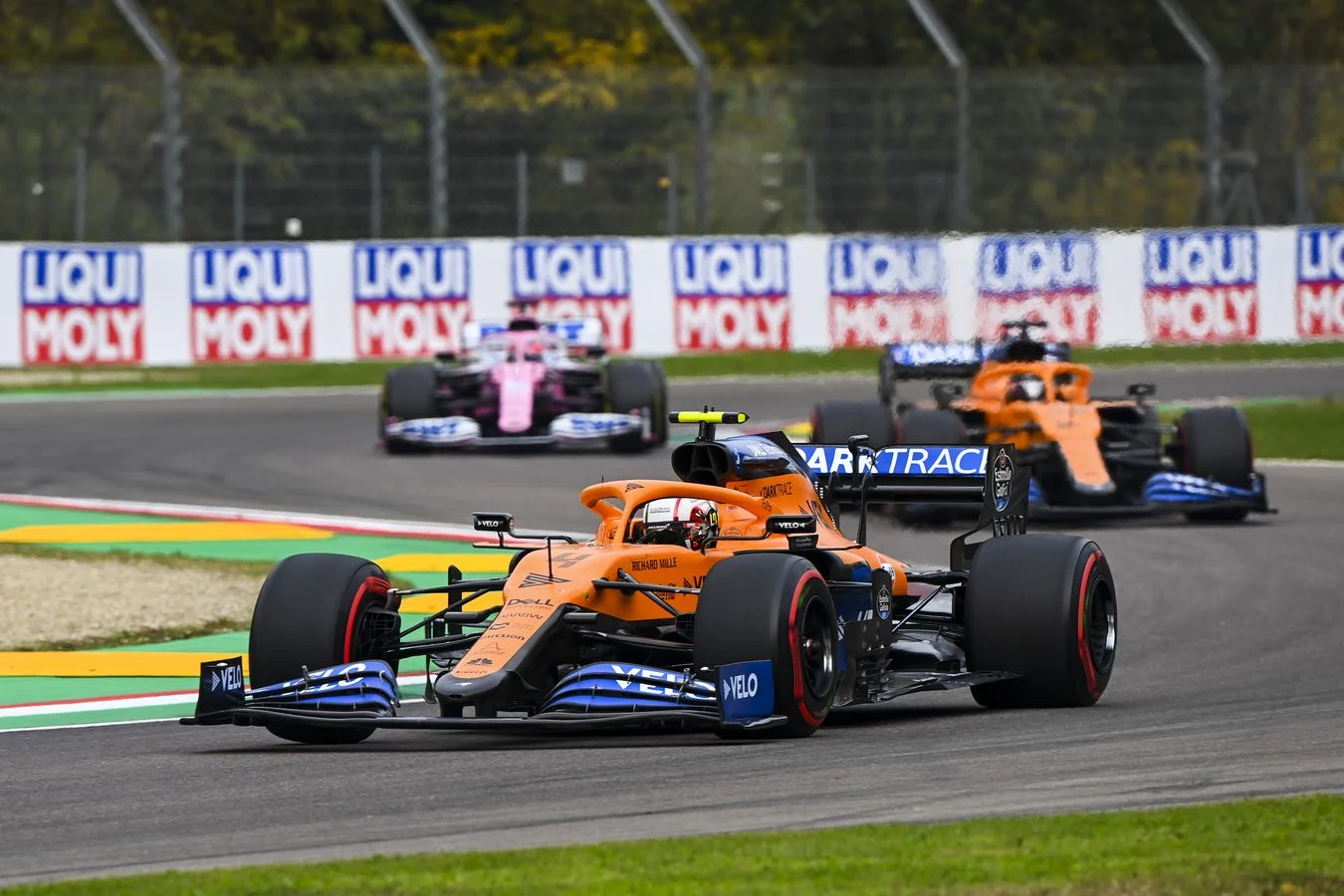
Both cars lost a place to Pérez, who was able to go long on his Medium tyres but were on the back of a rapidly compressing train approaching the last 20 per cent of the race, with P5 (Ricciardo) to P10 (Lando) covered by around seven seconds. At this point, on Lap 51, Max Verstappen had a tyre failure and spun out of P2, calling out the Safety Car, at which point Carlos was running P8 and Lando P9. Carlos pitted immediately and swapped to a Used Soft tyre. Based on where the Safety Car had emerged, Lando did not need to double-shuffle, and was able to make his pitstop subsequently, also taking on a Used Soft tyre. With the field bunched by the Safety Car, the race restarted with six laps remaining. Carlos and Lando gained a place when Alex Albon spun out. They finished the race P7 and P8.
While you would not rank Imola alongside Monaco or Singapore, there are at-least shades of the Hungaroring in the strategic imperatives at the Autodromo Internazionale Enzo e Dino Ferrari. Key to defending – or making places – was maintaining a good pace through the early phases of the race. Lando was called in on Lap 13 because the team did not want him to lose time fighting with Pérez, and spotted a good gap into which he could pit into. The team opted to fit the Medium tyre at this point because it got up to temperature quicker than the Hard compound, and would have better pace through Lando’s long stint, including the period early in the stint when he was most vulnerable to being passed by the midfield runners starting on the Medium tyre. While Pérez was always expected to gain, the primary concern was Ferrari’s Sebastian Vettel.
During the Safety Car, there was consideration given to leaving Lando out on his old Medium tyre. That would have promoted him to P6 on the road. Ultimately, the team decided to pit Lando. He had voiced a preference for coming in – but that was one of a range of factors that weighed into the decision.
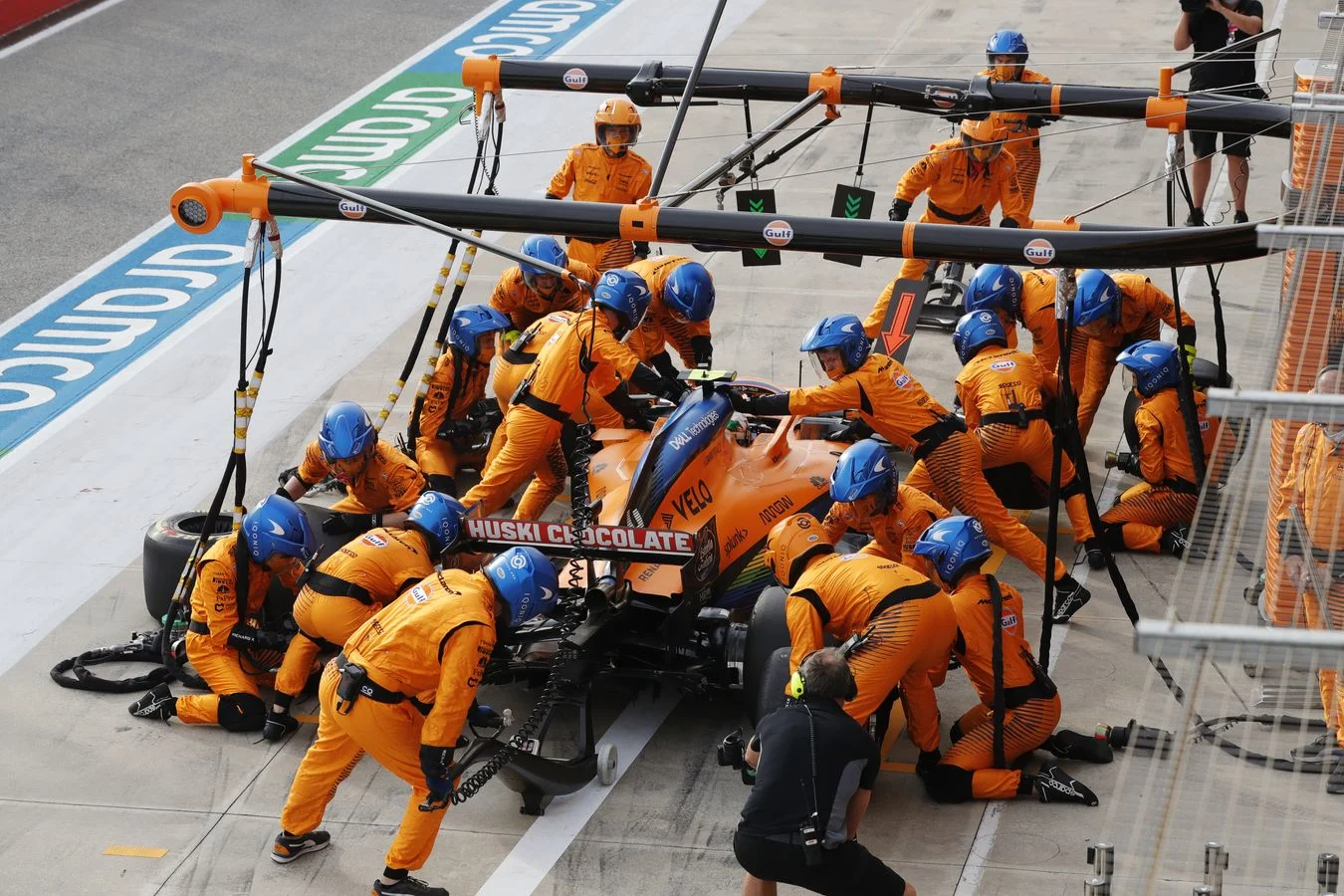
Carlos ran a very similar strategy to his team-mate. Consideration had been given to leaving him out longer but, in his case, the impetus for making his first stop on Lap 17 was also a desire to avoid getting into a time-sapping fight with Pérez – plus the possibility of jumping Kvyat. That failed to pay off when, despite completing his stop two-tenths of a second quicker than the Russian, he emerged a car’s length behind.
“With Carlos, we could extend a little further than we could with Lando, because Carlos was in a better position before the stops,” says Randy. “There was an opportunity to gain a position by pitting into the train of cars that were behind Ricciardo, but this time it didn’t pay off with the position.”
Like Lando, Carlos also took on the Soft tyre at the Safety Car, believing it would offer a restart advantage. Were these stops a good decision? It is still very difficult to say definitively. While Ricciardo prospered from staying out on his Hard tyre, the other leading cars taking the same approach – Alex Albon and Charles Leclerc – faired less well, with Albon losing places and spinning out, and Leclerc being passed by the freshly shod Kvyat.
“We’re still looking at whether we made a good decision with the Safety Car stops – I think it’s fair to say it wasn’t the easiest of decisions to make,” says Randy. “At the time, we considered boxing both cars, leaving both cars out or splitting them either way around.”
The race for the two McLaren drivers had been compromised a little by their starting positions but they clawed back a decent result by both finishing in the points for the first time since the Italian Grand Prix – something none of the team’s rivals managed. With four races of the season remaining, locked in a battle with only a point separating Renault, Racing Point and ourselves, the rest of the season is balanced on a knife-edge. Fantastic for fans: high pressure indeed for anyone calling the shots.
McLaren Plus is our free-to-join fan loyalty programme, bringing McLaren fans closer to the team with the most inclusive, rewarding and open-to-all fan programmes in F1 & esports.
Sign up now, or current members can amend their details in the form below if necessary.