McLaren's 50 Greatest Drivers

No 9 :: Peter Revson

Over the Years they have shown incredible bravery, amazing talent, unbridled enthusiasm and huge dedication to the cause. They are the men who have driven a McLaren racing car. Over the next year we will be counting down the 50 who have had the greatest impact on the McLaren cause.

Esteemed motorsport journalist ALAN HENRY has compiled the list and each week will reflect on one of our past drivers, giving his personal account of their contribution to the team.

We put some rules in place. Since this is about the greatest drivers in McLaren's history, there are no active drivers on the list, so no Lewis Hamilton, Jenson Button or Fernando Alonso for example. It’s not just F1 either, as McLaren cars have graced many series over the years. Also, the drivers are ranked on their contribution to McLaren only - not their overall career - so be prepared for a few surprises in the coming weeks and months! Enjoy, and let us know your thoughts as we spend a year in the company of many of racing history’s most awesome talents. 


No.9. Peter Revson

Born: 27 February, 1939, New York

Died: 22 March, 1974, Kyalami.

30 Grands Prix, 2 wins. Career span: 1964 (Parnell Lotus); 1971 (Tyrrell); 1972-73 (McLaren); 1974 (Shadow)

Scion of the Revlon cosmetics empire, this sleek and well-groomed American was initially snared by the uncompetitive Parnell squad which for the most part left him cast in the role of consistent also-ran close to the back of the field. He then scampered back across the Atlantic to build his reputation in Can-Am and other US categories. In that respect, during the early 1970s he would become a leading light in the works McLaren Indycar squad – bagging pole for the ’71 Indianapolis 500 at a record speed of just over 176mph. It was Mark Donohue and Johnny Rutherford who would score the famous wins at the Brickyard for the marque.

In 1971 he also made an inauspicious F1 return to drive a Tyrrell in the US GP at Watkins Glen; the clutch failed almost at the start, but that didn’t prevent the Yardley-backed F1 squad from recruiting him to drive for them for the next two seasons.

It would be fair to say that, during that time, Revson certainly confounded all his detractors. He was known as a solid and reliable performer, but now his turn of speed proved quite an eye-opener. He was a regular points scorer and, once he got his hands on the new McLaren M23 in 1973, he memorably won both the British and Canadian GP. He also hit the headlines in the society columns when he started dating the then-Miss World, American model Marjorie Wallace.

Despite his success, Revson had a sparky relationship with McLaren MD Teddy Mayer whose late brother Tim had been a classmate of Peter’s at Cornell University and a fledgling Formula Junior team-mate in the early 1960s. ‘Revvie’ decided to switch to the nascent Shadow F1 team in 1974 only to be tragically killed when his car suffered a front suspension failure and ploughed into the barrier at Kyalami’s tricky Barbecue bend while testing in preparation for the South African GP.


No.10. John Watson

Born 4 May, 1946, Belfast

152 Grands Prix, 5 wins.  Career span: 1973-74 (Brabham); 1975 (Surtees); 1976 (Penske); 1977-78 (Brabham); 1978-83 (McLaren)

John’s father Marshall was a successful Belfast motor trader and bankrolled his son’s racing right up to F2 in the early 1970s using family-owned Lotus and Brabham machinery. By 1973 John was ready for the move up into F1, making his debut in the British GP where he drove a Brabham BT37. In 1974 he drove for the private Hexagon Brabham F1 team fielded by prosperous Highgate car dealer Paul Michaels, scoring his first world championship point with a sixth place at Monaco.

In 1975 he briefly drove for Team Surtees before switching to the American Penske squad, scoring a poignant victory in the ’76 Austrian GP just 12 months after Penske’s original driver Mark Donohue was fatally injured. It was a truly great win by Watson, but he would have to wait another five years to score his second GP win. This time it would be at Silverstone and a maiden victory for the trend-setting carbon fibre McLaren MP4 designed by John Barnard and managed by the team’s new boss, Ron Dennis.

John was a quick and highly professional driver, even if he also had a frustratingly perfectionist streak when it came to the intricacies of chassis set-up. But, out of the cockpit, he sometimes seemed to lack the hard-edge displayed by some of his team-mates, most notably Niki Lauda whom he had two stints running alongside, at Brabham in 1978 and again at McLaren in 1982-83. Even so, his wins through the streets of Detroit in ’82 and Long Beach the following year were absolutely brilliant performances which were to be envied and admired in equal measure.

At the end of 1983, Alain Prost came onto the driver market at a bargain basement price tag. Ron Dennis snapped up his services and that was the end of ‘Wattie’s’ F1 career.


No.11. Denny Hulme

Born 18 June, 1936, Nelson, South Island, NZ

Died: 4 October, 1992, Bathurst, NSW, Australia.

112 Grands Prix, 8 wins; World Champion, 1967. Career span: 1965-67 (Brabham); 1968-74 (McLaren)

Clive Hulme, father of the 1967 world champion, won a Victoria Cross at Anzio and, in essence, that is  pretty much all you need to know about his son Denis Clive Hulme – “Denny” to most of his friends, and “The Bear” to those who got on the wrong side of him.

Denny was a tough old number by any objective standards. Legend has it that during his youth he was doing some welding in his father’s garage when he smelled burning. As it happened, he had trodden on a spark; but had smelled it before the burning sensation started to drill through the sole of his foot! Many years later he would bear the searing pain and discomfort of methanol burns to his hands – sustained while testing at Indianapolis when a fuel filler cap worked loose on the first McLaren Indycar – similarly without a murmur.

This tough New Zealander was, in oh-so-many ways, as big a contributor to the McLaren motor racing legend as the team founder Bruce McLaren. He drove only for Jack Brabham and Bruce throughout his F1 career and although he won his only title crown driving for Jack, he quickly made McLaren his home, relishing the image of two Kiwis against the world. He stayed with McLaren until the end of his career, although Bruce’s death in the summer of 1970 devastated his otherwise outwardly granite exterior. His final Grand Prix victory came at Buenos Aires in 1974 after an archetypal Hulme-style drive; taking things easy in the opening stages, conserving the car and then pressing home his attack when the opposition ran into trouble.

He retired at the end of the 1974 F1 season but would die at the wheel of a BMW touring car while racing at Bathurst some 18 years later. 


No.12. Johnny Rutherford

Born March 12, 1938, Coffeyville, Kansas.

Made Indycar debut in 1962 Hoosier 100. 27 Indycar race victories. Won Indianapolis 500 for McLaren in 1974 and 76, then again in John Barnard-designed Chaparral in 1980. CART Champion in 1980.

Born John Sherman Rutherford III, this distinguished American racer made Texas his home and so not for nothing became nicknamed ‘Lone Star JR’ during a glittering career which saw him win the Indy 500 twice for McLaren, earning him a worthy position in our personal Top 50 team drivers even though he never so much as sat in an F1 car, let alone competed in one.

From racing ‘modifieds’ at the Devils’ Bowl Speedway at Dallas, Texas, to what he describes as his ‘vagabond life’ as a driver for hire in the early 1960s, Rutherford demonstrated the tenacity and determination of a true champion. “All I ever wanted to do was drive a race car, any time, anywhere,” he would say as he struggled his way up the greasy pole to front-running success. All this was achieved during a career punctuated by a number of spectacular accidents, the most serious of which occurred at the Eldora Speedway, Rossburg, Ohio, early in 1966 when Rutherford’s sprint car somersaulted off the track and over the retaining barrier. He suffered multiple injuries from which he was very fortunate to make a complete recovery.

During 1974, not only did he post his first Indy 500 victory but also became the first driver ever to win two 500-mile races during the same season. When he won Indy for the third time six years later he became only the sixth driver in history to have won the classic American race on three occasions.  He retired in 1994 at the age of 56.


No.13. Dan Gurney

Born 13 April, 1932, Port Jefferson, New York

86 Grands Prix, 4 wins

Career span: 1959 (Ferrari); 1960 (BRM); 1961-62 (Porsche); 1963-65 (Brabham); 1966-68 (Eagle); 1970 (McLaren)

An affable, lanky son of an opera singer, Dan Gurney played only a brief walk-on role in the McLaren F1 story, driving a handful of races for the team during the summer of 1970 in the wake of Bruce McLaren’s tragic death at Goodwood. Dan had been drafted in to fill the void, but at 38 years of age the competitive spark had dimmed. With admirable candour he recognised that fact, returned to the USA and announced his retirement.

Although Gurney won just four Grands Prix in his career, he is remembered beyond question as one of the very finest drivers of his generation, one of the few men to stand comparison with the legendary Jim Clark, a man he respected enormously. He also stands shoulder-to-shoulder with Mario Andretti as the best American F1 driver of all time.

After a spell with the US army in Korea during the early 1960s, Gurney threw himself into club racing on the west coast of the USA, eventually going to Italy for a test drive at Modena in a Ferrari sports car. He pressed all the right buttons and by 1960 was a member of the Ferrari f1 team, then switched through BRM, Porsche and Brabham to fielding his own elegant Eagle machines, one of which carried him to a fine victory in the 1967 Belgian GP at Spa. It was the high point of Dan’s illustrious career.


No.14. Gerhard Berger

Born: 27 August, 1959, Worgl, near Innsbruck

210 Grands Prix, 10 wins

Career span: 1984 (ATS); 1985 (Arrows); 1986 (Benetton); 1987-89 (Ferrari); 1990-92 (McLaren); 1993-95 (Ferrari); 1996-97 (Benetton)

There was always an outward effervescence about Gerhard Berger when he was away from the intense business of the F1 pit lane and sometimes this concealed the sheer steel and determination which lurked close to the surface of this intensely competitive Austrian’s chacracter.

Blooded in the high pressure political environment which was the Ferrari team of the mid-1980s, he then faced the unenviable task of succeeding Alain Prost in the McLaren-Honda squad as team-mate to the legendary Ayrton Senna at the start of 1990.

With F3 and touring car experience under his belt, this son of an Austrian haulage contractor breezed into F1 at the wheel of an ATS-BMW in the summer of 1984. He failed to finish on his debut outing in front of his home crowd at Osterreichring, but followed that up with a fine sixth at Monza although he did not collect the championship point which normally went with it as he was not an officially registered title contender.

In 1985 he drove for the Arrows-BMW squad then switched to the emergent Benetton-BMW team in 1986, winning the Mexican Grand Prix and netting a three year Ferrari contract on the strength of that and a number of consistently good performances. In ’87 he won the Japanese GP at Suzuka and the Australian GP at Adelaide, then in 1988 he was the only non-McLaren driver to win a race with a lucky victory at Monza ahead of team-mate Michele Alboreto.

This was followed by a rotten year in 1989 – now partnered by Nigel Mansell – before he joined McLaren where he would spend three years trying to come to terms with Ayrton Senna as his team-mate. Berger became one of Ayrton’s closest  friends, always telling the Brazilian his opinion in candid, take-it-or-leave it style. Being paired with a genius like Senna was never going to be easy, but Berger made the best of it.

After leaving McLaren he returned to Ferrari for another three year stint followed by two more years at the wheel of a Benetton-Renault, scoring his last F1 victory at Hockenheim ’97, poignantly only a few days after his father was killed in a light aircraft accident.


No.15. Kimi Räikkönen

Born 17 October, 1979, Espoo, Finland

156 Grands Prix, 18 wins. World Champion 2007

Career span: 2001 (Sauber); 2002-06 (McLaren); 2007-09 (Ferrari)

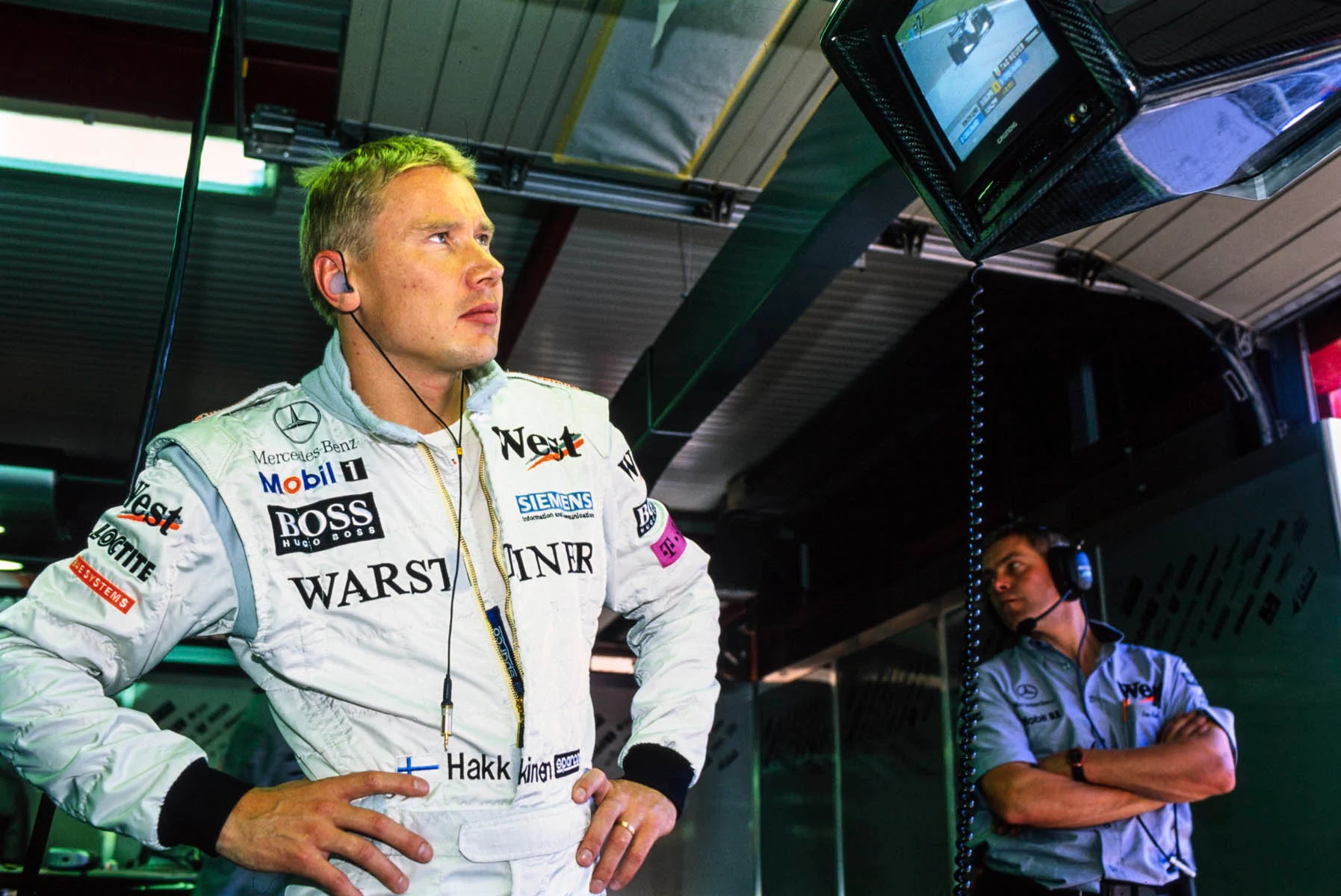
Kimi Räikkönen was another distinguished Flying Finn following in the McLaren wheel tracks of twice world champion Mika Häkkinen, although Kimi did not manage to emulate Mika’s achievement until he joined Ferrari after a four year spell with the Woking squad. Having graduated from karting like most of his contemporaries, Räikkönen spent just one season in Formula Renault before being head-hunted by the enterprising Sauber F1 team who shrewdly promoted the young Finn to the sport’s most senior category at the start of the 2001 campaign.

Moody, mean and motivated, Räikkönen was a formidable competitor on his day although he had to wait longer than most expected – to the 2003 Malaysian GP – before posting the first of his 18 F1 victories achieved so far. One of his most memorable victories came at Suzuka in 2005 when he brilliantly outfumbled Giancarlo Fisichella’s Renault going into the first corner of the race’s final lap to beat the bewildered Italian by just over a second. At the end of 2006 he decided to switch to Ferrari, driving brilliantly to pip Lewis Hamilton to the title crown, but this was followed by two lacklustre seasons and he left F1 at the end of 2009 to spend two years trying his luck in the World Rally Championship.

Kimi had little luck with this career detour and signed a two-year deal to return to F1 in 2012 with the Lotus-Renault squad, hoping to pick up the threads of his successful time in his heyday with McLaren and Ferrari. Time alone would tell how successful he would be.


No.16. Mark Donohue

Born: 18 March, 1937, Summit, New Jersey

Died: 19 August 1975, Graz, Austria.

14 grands prix, no wins. Career span: 1971 (McLaren); 1974 (Penske); 1975 (March)

One of the great technical drivers of his era, Donohue won the Can-Am sports car championship in a Porsche and scored the first of three McLaren victories in the Indianapolis 500 driving Roger Penske’s private M16B in the 1972 running of the Memorial Day classic.

Late in 1970 Roger and Mark had come to the UK to buy a Lola Indycar, but after they dropped by at McLaren to see what the team had in mind they immediately switched their order to acquire one ofthe new M16Bs. That was the start of a relationship which would eventually see Donohue take over the works M19 A F1 car for the 1971 Canadian GP at Mosport Park, the car resprayed in Penske’s blue livery for the occasion. Mark found the car difficult to drive, echoing the concerns of previous incumbents Denny Hulme and Peter Gethin, but the American drove well to finish third behind Jackie Stewart’s Tyrrell and Ronnie Peterson’s March.

In 1974 Penske decided to build his own F1 car, but in 1975 switched to a customer March 751.  During the race morning warm-up for the Austrian GP Donohue suffered a tyre failure and crashed heavily on the fast right-hander beyond the pits at the Osterreichring. Despite initially sitting up and talking, it soon became clear that a blow on the head had inflicted severe brain injuries on the American driver and Mark died in a Graz hospital three days later.


No.17.  Juan Pablo Montoya

Born 20 September, 1975, Bogota

95 Grands Prix, 7 wins.

Career span: 2001-04 (Williams); 2005-06 (McLaren)

Montoya was one of the most exciting drivers to be employed by McLaren in recent years, but he never really realised his full potential after a promising start to his career. Winner of the 1998 Formula 3000 championship he moved to the USA in 199 where he won the CART Championship and was one of only two drivers – the other being Nigel Mansell – to win the CART title in his freshman year.

After also winning the Indy 500, Montoya made his F1 debut for Williams at the start of 2001, scoring his first victory in that year’s Italian GP. He would have to wait until 2003 before scaling the top spot on the podium again, winning that year’s Monaco and German races, and then rounded off his Williams career with victory in the 2004 Brazilian race before switching to McLaren for 2005 alongside Kimi Raikkonen.

Montoya quickly demonstrated to McLaren that he had what it took to compete at the highest level and, alongside Kimi, made a formidable pairing for the 2005 seasons. His wins in the British, Italian and Brazilian GPs were copybook performances, but somehow he seemed to struggle at the start of 2006 and could not quite seem to be able to produce the form he had demonstrated the previous year. He also preferred living and racing in the USA so when the opportunity for him to switch to NASCAR presented itself McLaren and Montoya went their separate ways after that year’s US GP at Indianapolis. 


No.18. Jody Scheckter

Born 29 January, 1950, East London, SA.  112 Grands Prix, 9 wins. World Champion 1979.

Career span: 1972-73 (McLaren); 1974-76 (Tyrrell); 1977-78 (Wolf); 1979-80 (Ferrari)

In his formative years Jody was as wild and unrestrained behind the wheel as he was brilliantly talented. The curly-haired South African was quickly afforded the nickname ‘Fletcher’ after the baby seagull in the book Jonathan Livingstone Seagull, who tried to fly when he was too young and kept on crashing into the cliff face.

Jody arrived in the UK to race Formula Ford in early 1971 and breezed through FF1600 and F3 with such good effect that he was at the wheel of a works McLaren M19A in time for the following year’s US Grand Prix at Watkins Glen. This dazzling progress continued, and in 1973 he  led the French GP at Paul Ricard in one of the new McLaren M23s before being pushed off by Emerson Fittipaldi’s Lotus 72.

A couple of weeks later he ensured that McLaren hit the headlines in the British GP at Silverstone. Trying too hard too soon, Jody ran wide coming out of Woodcote corner on the opening lap; his M23 spun back across the track and, in the process, triggered a multiple pile-up which resulted in the race being stopped!

Although tipped to have a long-term future with McLaren, instead he was signed to lead the Tyrrell team in 1974 in the wake of Jackie Stewart’s retirement. Under Ken’s stern tutelage he began to calm down and won that year’s British and Swedish GPs. He stayed with Tyrrell for three years, but then signed for the emergent Walter Wolf Racing team which planned to field a single car in 1977 designed by the respected Harvey Postlethwaite and run by former Lotus team manager Peter Warr.

Scheckter very nearly won the 1977 championship in the Wolf, winning three Grands Prix but ending up as runner-up behind Niki Lauda. The 1978 season saw the Wolf squad lose momentum and when the offer of a Ferrari drive came up for 1979, Jody did not hesitate. Many observers felt that Jody was biting off more than he could chew throwing in his lot with Maranello, but he successfully saw off his tempestuous young team-mate Gilles Villeneuve to win the world championship in the bullet-proof Ferrari 312T4. In 1980, the Ferrari 312T5 was a hopeless successor to the title winning machine and Scheckter retired from racing at the end of that season.


No.19. Stefan Johansson

Born 8th September, 1956, Vaxjo, Sweden. 79 Grands Prix, no wins.

Career span: 1979 (Shadow); 1983 (Spirit); 1984 (Tyrrell and Toleman); 1985-86 (Ferrari); 1987 (McLaren); 1988 (Ligier); 1989 (Onyx); 1991 (AGS).

This cheerful Swede had all the right credentials when he finally graduated into F1 with the fledgling Spirit-Honda team in the summer of 1983. A successful kartist, winner of the 1979 British F3 championship and an F1 pace-setter, Johansson was quick, brace and obviously talented.  He was also immensely unlucky and, despite spells with Ferrari and McLaren, he never quite string all the variables together to score that elusive F1 victory.

When Honda switched their engine supply contract to Williams for 1984, Johansson simply filled in as best he could, accepting occasional guest outings with Tyrrell and Toleman. In the Italian GP, standing in for the suspended Ayrton Senna, he brought the Toleman home in a fine fourth place on the strength of which he earned the number one drive with them for 1985.

Just when it seemed as though he was poised on the threshold of success, the lack of a tyre contract prompted Toleman to shelve the programme. However, Ferrari created a timely vacancy when Rene Arnoux was dropped from the line-up and Johansson took his place.

Stefan ran competitively through 1985, finishing a strong second in both Canada and Detroit, consolidating a reputation which kept him in the Maranello squad. But Ferrari’s competitiveness would wane through 1986 and a successions of problems combined with bad luck resulted in his being replaced by Gerhard Berger in 1987.

Johansson would them be selected for the prestigious number two McLaren-TAG drive alongside Alain Prost in 1987, but this was simply a question of the likeable Swede keeping the seat warm for Ayrton Senna who would join the team in 1988. From then on, Johansson drove for a succession of minor league teams before decamping to North America where he would have a measure of success as an IndyCar driver and team owner.
 

No.20. Martin Brundle

Born June 1, 1959, Kings Lynn

158 Grands Prix, no wins

Career span: 1984-86 (Tyrrell); 1987 (Zakspeed); 1989 (Brabham); 1991 (Brabham); 1992 (Benetton); 1993 (Ligier); 1994 (McLaren);1995 (Ligier); 1996 (Jordan).

Martin Brundle came to McLaren relatively late in his F1 career, turning down an opportunity with Jordan in 1994 to wait for a possible opportunity with Ron Dennis. There was a chance, just a chance, that Alain Prost might have come out of retirement to partner Mika Hakkinen in the new McLaren-Peugeot line-up that year, but Martin correctly judged that the Frenchman would not do it in the end. He was absolutely right and got the drive.

The McLaren-Peugeot was not the most competitive car on the grid, but Brundle drove magnificently at Monaco to finish second behind Michael Schumacher, Martin actually closing in on his former team-mate despite the fact that the Peugeot V10 had consumed most of its oil and water by the time it reached the chequered flag.

Brundle was always an astute gambler when it came to judging what move to make next for the benefit of his professional career. Few drivers have taken the risk of stepping down from F1 in a bid to consolidate their racing career, but that’s what the popular Brundle did. Twice.

At the end of 1987, frustrated by his lack of success with Zakspeed, he reasoned that a spell with the highly competitive TWR Jaguar sports car team would better serve his long-term career interests.

Twelve months later, as World Sports Car Champion, Brundle was restored to the Grand Prix elite as a member of the seemingly revitalised Brabham team. However, at the end of 1989, he decided to take up another deal with Jaguar, winning the 1990 Le Mans 24-hours before returning to Brabham in 1991.

For much of his career Brundle, an extremely convivial personality, was regarded as significantly better than most of the machinery he was driving. His father John was a keen rally driver and a successful motor trader, so Martin was born into a world of fast cars and cut his teeth in saloons before switching to F3 in 1982.

The following season saw him fighting tooth and nail for the British F3 title with no less a celebrity than Ayrton Senna who pipped him in the very last race. Poignantly, when he joined McLaren in 1994, it was Senna’s place he was taking in the team after the brilliant Brazilian moved to rivals Williams.


No.21. Gilles Villeneuve

Born 18 January, 1950, Berthierville, Quebec

Died, 8 May, 1982, Zolder, Belgium.

67 Grands Prix, 6 wins.

Career span: 1977 (McLaren); 77-82 (Ferrari)

This tiny French Canadian was one of those rare sporting personalities who became a legend in his own lifetime. Villeneuve was cast in an heroic mould, his fearless and undaunted approach to his chosen sport giving rise to more discussion and debate that any of his contemporaries. Some thought him wonderful, embodying all those romantically traditional qualities which go into making F1 such a compelling sport. Others dismissed his opposite-lock, tyre-smoking antics as a waste of energy.

Either way, Villenueve was undoubtedly a great driver who knew no other way to drive than flat-out all the time. Personal risk didn’t come into his personal equation at all. He began racing snowmobiles in his native Quebec at the age of eight, displaying from the outset an uninhibited flair which was to become the hallmark of his tragically brief motor racing career.

Gilles rocketed to international prominence when he won the Formula Atlantic race through the streets of Trois Rivieres on the banks of the St Lawrence River in 1976. In the process he beat Alan Jones and McLaren star James Hunt into second and third places. Hunt, ever generous in his praise for other competitors he believed were truly gifted, came straight back to the UK and told McLaren boss Teddy Mayer that Villeneuve was a driver seriously worth watching.

Mayer duly agreed to run Gilles in a third works M23 in the following year’s British GP at Silverstone where he proved Hunt correct. He qualified an impressive ninth, then finished tenth after being delayed by a pit stop to deal with a faulty fuel pressure gauge. Despite this superb showing Mayer opted to sign Patrick Tambay as a replacement for Jochen Mass in 1978, a decision which seems truly unfathomable to this day.

Gilles quickly made himself at home in F1. It took only until the third race of 1978, through the streets of Long Beach, California, for him to lead commandingly, although he was eliminated by an error of judgement when he tripped over Clay Regazzoni’s Shadow DN8 as he was lapping the slower car. By the end of the season, however, he celebrated his first F1 victory with a superb success in the Canadian GP at Montreal.

In 1979 Gilles was paired with Jody Scheckter and, armed with the superb Ferrari 312T4, added victories at Kyalami, Long Beach and Watkins Glen to his tally. From the start of the year he knew that he was cast in the supporting role to Scheckter, so when it came to following Jody round at Monza, knowing that he only had to overtake his colleague to win the world championship, Gilles’s integrity ensured that he held position and never tried to breach team orders by attempting to pass.  This dynamic young charger eventually paid the price for his dauntless driving style, crashing to his death practising for the 1982 Belgian GP at Zolder, going to his grave suffused with anger after being double-crossed by his team-mate Didier Pironi who himself had won the San Marino GP ahead of Villeneuve – and in breach of team orders – a fortnight before. 


No.22. Jochen Mass

Born 30 September, 1946, Munich

105 Grands Prix, 1 win.

Career span: 1973-74 (Surtees); 1974-77 (McLaren); 1978 (ATS); 1979-80 (Arrows); 1982 (March)

Jochen was affectionately nicknamed ‘Hermann the German’ by the McLaren team in general and his team-mate James Hunt in particular. Imbued with a sunny disposition and equable temperament, the tousle-haired Jochen was a one-time able seaman who started competing in sprints and hill climbs in an Alfa Romeo Giulia Sprint.

He gained international prominence behind the wheel of Ford Capris in the European Touring Car Championship in the early 1970s, but gained promotion to F1 on the strength of some strong showings in F2 single-seaters. His GP debut came for Surtees at Silverstone in 1973, the race in which Jody Scheckter catapulted McLaren into the headlines for all the wrong reasons when he triggered the multiple pile-up which caused the race to be stopped in chaos.

Jochen switched to McLaren towards the end of 1974, taking over the Yardley M23 previously driven by Mike Hailwood and David Hobbs. In 1975 he was promoted to the ‘main’ squad as team-mate to Emerson Fittipaldi, winning the famous ‘half points’ Spanish GP at Barcelona’s wild and woolly Montjuich Park circuit, an event which was flagged to a premature halt after Rolf Stommelen’s Hill GH1 crashed over the trackside barrier, killing four onlookers.

After Hunt’s arrival at McLaren as Fittipaldi’s successor, Mass gradually found himself slipping into a subordinate role alongside his new British colleague. His inability quite to match Hunt’s sheer speed seemed to wear him down. He was replaced by Patrick Tambay in the McLaren line-up for 1978, switching instead to the ATS team for a disastrous season which ended with a broken leg. Two years driving for Arrows followed, then a dreadful year with the RAM March squad after which he turned his back on F1 and enjoyed considerable success with the Porsche sports car racing team.


No.23. Mike Hailwood

b. 2 April, 1940, Oxford

d. 23 March, 1981, near Tanworth-in-Arden.

50 Grands Prix, no wins. Career span: 1963-65 (Parnell Lotus); 1971-73 (Surtees); 1974 (McLaren).

Mike Hailwood’s tenure with McLaren was brief, not particularly successful, but in no way representative of the former motorcycle ace’s potential on four wheels. Stanley Michael Bailey Hailwood was probably the most gifted motorcycle racer in history, so it was sad for his legions of fans that his transition to cars was not marked by a similar level of achievement.

‘Mike the Bike’ first dabbled in F1 back in 1964 when he handled a Parnell Racing Lotus 25 fitted with a BRM engine, his only championship point coming with a sixth place at Monaco.  After this disappointing foray, Hailwood did not reappear in F1 for six years, celebrating his return with a storming fourth place in the 1971 Italian GP at the wheel of a Surtees. In 1972 he won the European F2 championship for ‘Big John’s’ team and was poised to grab the lead of that year’s South African GP at Kyalami when a rear suspension breakage spun him into retirement.

Surtees and Hailwood were very different characters, but their background in motorcycle racing ensured that they developed a workable alliance. Mike was genial, kind and totally without any of the pretence one might have expected from a millionaire’s son. He could be quite a handful socially when he let his hair down, but there was no doubting his professionalism and focus.

However, frustrated by lack of success with Surtees, Mike switched to McLaren in 1974, driving the single Yardley-backed M23 operated by Phil Kerr which was seperate from the Marlboro-backed machines handled by Emerson Fittipaldi and Jochen Mass. There were flickers of promise, but Mike’s spell with McLaren – and his car racing career – ended when he crashed heavily during the German GP at Nurburgring, sustaining serious leg injuries.

Yet there was a great encore still to come for ‘Mike the Bike.’ In 1978 he returned to the Isle of Man to score a sensational victory in the F1 TT on a 900cc Ducati. Just to prove that this was no fluke, he was back in 1979 to win the Senior TT on a 500cc Suzuki.

After that this great man retired for good, tragically to be killed, along with his young daughter Michelle, when Mike’s Rover saloon collided with a lorry which was executing an illegal U-turn on a dual carriageway close to their Warwickshire home. The entire motorsport community was left bereft and aching with sorrow.


No.24. Patrick Tambay

b. 25 June, 1949, Paris

114 Grands Prix, 2 wins.

Career span: 1977 (Ensign); 1978-79 (McLaren); 1981 (Theodore and Ligier); 1982-83 (Ferrari); 1984-85 (Renault); 1986 (Haas Lola).

A cosmopolitan and cultured individual, Tambay was educated in France and the USA and made a name for himself as a talented downhill ski racer before motor racing caught his eye at the end of 1971. Although he would widely become acknowledged as one of the most genuinely charming personalities on the F1 stage by the early 1980s, this debonair Frenchman never quite reaped the hard results suggested by his early promise.

Nevertheless, it seemed from the outset that Patrick would become a high flier, winning the prestigious Volant Elf competition at the Paul Ricard driving school after which he successfully bypassed F3 after two seasons in Formula Renault. Then he moved smoothly into the European F2 championship arena and also sampled Can-Am sports cars in North America before his F2 exploits earned him an F1 chance at the wheel of an Ensign entered by wealthy Hong Kong enthusiast Teddy Yip in the 1977 British GP. After scoring no fewer than five championship points in his first six Grands Prix, Patrick earned a place in the McLaren squad for 1978 as James Hunt’s team-mate.

Disappointingly by this stage, McLaren was losing its competitive edge as rival teams’ ground effect chassis technology outperformed their own. As a result, Tambay found the M28 instantly outclassed from the start of 1978 and had two very lean seasons before being replaced by compatriot Alain Prost from the start of 1980. But, as events proved, Patrick’s best days were ahead of him as far as F1 was concerned, including a couple of wins for Ferrari which certainly perked up his CV and helped him land a works Renault drive for two years in the mid-1980s.


No. 25. Mark Blundell

b. 8 April, 1966, Barnet

61 Grands Prix, no wins.

Career span:  1991 (Brabham Yamaha); 1993 (Ligier); 1994 (Tyrrell); 1995 (McLaren)

Mark was a popular member of the McLaren squad, first as a test and development driver and latterly as replacement for Nigel Mansell on the race team in 1995 after the deal with the ’92 world champion petered out following a handful of undistinguished races.

The cheerful and breezy Blundell started with motocross in 1980 and pursued a career on two wheels until switching to cars in 1984 with dramatic and immediate success in Formula Ford and FF2000. He moved into F3000 in 1987 and impressed watching F1 team managers with a strong drive to second place in the Belgian GP supporting race at Spa. Then in 1988 he finished sixth in the International F3000 championship and expanded his racing experience by being recruited to drive for Nissan in Group C as well as being recruited as a test driver for the Williams F1 team in 1990.

Mark’s best placing in 1991 was a strong sixth place at Spa, but financial pressures on Brabham meant that he was replaced the following year by a sponsored driver. Nevertheless he was kept extremely busy in 1992 as chief McLaren test driver which helped steer him back into the racing mainstream with Ligier and Tyrrell over the next two years.


No.26. Brian Redman

b. 9 March, 1937, Burnley, Lancashire.

12 Grands PrIx, no wins.

Career span: 1968 (Cooper); 1972 (McLaren); 1974 (Shadow).

One of the great sports car racing drivers of his era, Redman was an enormously versatile all-rounder with an attractively straightforward personality which made him hugely popular. It was therefore disappointing that his fleeting and occasional F1 outings served almost as an irrelevant footnote to a glittering career in almost every other category.

Brian’s early career was closely linked with the emergence of the Bolton-based Chevron sports car company and his first F1 involvement came courtesy of the works Cooper team, although this partnership ended prematurely with a badly broken arm sustained when his T81 suffered a suspension breakage and crashed heavily in the Belgian GP.

A brief sojourn in retirement living in South Africa at the start of 1971 was followed by a return to international racing in 1972-73 as co-driver to Jacky Ickx in the Ferrari endurance racing team. He also had a handful of races for McLaren in 1972, during which period he convinced those he worked with on the team that he had the talent for F1, if not perhaps the inclination. Eventually Redman withdrew from the fringes of F1 from choice after three races for Shadow in 1974, as one of the temporary successors to his former McLaren team-mate Peter Revson who had been killed in a Shadow testing at Kyalami earlier that season.


No.27. Alexander Wurz

b. 15 February, 1974, Waidhofen am der Thaya, Lower Austria.

69 Grands Prix, 0 wins.

Career span; 1997-2000 (Benetton); 2001-06 (McLaren); 2007 (Williams)

One of the most popular McLaren drivers of recent years, Wurz fulfilled the valued role of test and reserve driver from 2001 to 2005 with the team in between race driving stints for Benetton and Williams. The taste for competitive sports ran in the Wurz family blood, his father Franz winning the European Rallycross Championship on no fewer than three occasions.

Alex followed his father into motorsport through karting, then Formula Ford and through into the German F3 championship in 1993. Stints in DTM and sports car racing followed and in 1996 he became the youngest ever winner of the Le Mans 24-hour race, a distinction he retains to this day.

In 1997 he was signed as reserve driver for the Benetton F1 squad, finishing third at Silverstone on only his third race as stand-in for the unwell Gerhard Berger. In 1998 he signed for Benetton as one of the fulltime race drivers, a role he retained alongside Giancarlo Fisichella for the next three seasons. Unfortunately Alex’s time at Benetton disappointingly delivered much less than he had expected. He memorably held second place ahead of Michael Schumacher’s Ferrari at Monaco in 1998 only for the two cars to collide, the Benetton suffering broken suspension which caused Wurz to crash heavily coming out of the tunnel.

Unable to find a seat with a leading team, Wurz accepted an invitation to become McLaren’s third driver. He was the favoured stand-by driver, but had to wait until the 2005 San Marino GP at Imola to have his first and only drive for the team, handling the challenge superbly to finish fourth, which was promoted to a podium-placing third after the BAR-Honda cars were disqualified. What made this a particularly impressive performance as his tall frame did not comfortably fit into the McLaren chassis and at times had to drive with one hand.

At the start of 2006, Wurz switched to the Williams team as their official reserve and test driver, then succeeded Mark Webber as a fulltime member of the race team alongside Nico Rosberg for 2007. At the end of the year the popular Wurz announced his retirement from F1, very honestly citing doubts about his continuing competitive commitment.


No.28. Tim Mayer

b. 22 February, 1938, Dalton, Pennsylvania

d. 28 February, 1964, Longford, Tasmania

Brother of future McLaren team principal Teddy Mayer, Tim could effectively lay claim to being the first McLaren team driver hired by Bruce in the early years, joining the New Zealander to drive one of Bruce McLaren Motor Racing’s specially built 2.5-litre Cooper-Climax single seaters in the 1964 Tasman Series.

Mayer had started racing in an Austin Healey and competed with distinction in Formula Junior whilst studying English Literature at Yale in 1958. Teddy was effectively running a three-car F3 team for his brother, Peter Revson and a friend called Bill Smith, under the Rev-Em Racing team banner.  Throughout 1962 they ran a trio of Coopers in 16 races, winning 15, on the strength of which Tim was invited for a Formula Junior test driver with Ken Tyrrell in the UK. Young Mayer would also have his sole GP outing that year driving an uncompetitive works Cooper at Watkins Glen where he failed to finish.

He then raced in Europe with the Tyrrell Cooper-BMCs in 1963, impressing the British racing fraternity, although the BMC engines were not in the same class as the Cosworths used by the Lotus opposition. On Tyrrell’s recommendation, John Cooper was anxious to sign Timmy to drive alongside Bruce in his F1 squad for 1964, but at the start of that season the young American crashed fatally practising for the Tasman race on the challenging Longford road circuit in Tasmania and the sport was robbed of one of its great potential future talents.


No.29. Jacky Ickx

b. 1 January, 1945, nr Brussels.

116 Grands Prix, 8 wins.

Career span: 1967 (Cooper); 1968 (Ferrari): 1969 (Brabham); 1970-73 (Ferrari): 1973 (McLaren and Williams); 1974-75 (Lotus); 1976 (Williams and Ensign); 1977-78 (Ensign); 1979 (Ligier)

Civilised, articulate and talented, Jacky Ickx’s early motor racing exploits  marked him down as a potential world champion even before he ever sat in a Grand Prix car. But somehow the cards never quite fell in the direction of this charming Belgian driver despite some quite brilliant drives for Brabham and Ferrari between 1968 and 72.

The son of the respected Belgian motoring journalist of the same name, Jacky began his career successfully in motorcycle trial events and later raced a Lotus Cortina with great success in saloon car events. He exploded to prominence at the age of 22 when he drove a Tyrrell F2 Matra MS7 with remarkable zest in the German GP at Nurburgring, running amongst the leading half dozen before the French machine broke its suspension.

Ickx crossed McLaren’s path on two occasions. In 1973 he was invited to drive a third works Yardley M23 in the German GP at Nuburgring, a race he had won brilliantly twice before in 1969 and 72, and he finished third behind the Tyrrells of Jackie Stewart and Francois Cevert.

After his retirement from F1 he later became Clerk of the Course for the Monaco Grand Prix, but had his licence withdrawn in absolutely outrageous circumstances following the 1984 race when he was obliquely accused of favouring Alain Prost’s McLaren-TAG which emerged victorious as Ickx flagged the race to a premature halt in monsoon conditions. Ickx’s links with Porsche, who had built the TAG turbo V6 engines used by McLaren, made him partial, so the critics said. Truth be told, it was a ludicrous reflection on the FIA’s inability at the time to administer the sport on an even-handed basis. Gentlemen who knew their stuff like Ickx were badly needed on the administrative side of the sport during that period. It was a sad episode.


No. 30: Vic Elford

b. 10 June, 1935, Peckham, South London

13 Grands Prix, 0 wins.

Career span: 1968 (Cooper); 1969 (Cooper and McLaren); 1971 (BRM)

This international works Ford rally star finished fourth on his GP debut in the 1968 race at Rouen-les-Essarts at the wheel of a works Cooper-BRM T81C and drove for the team throughout the balance of that season. In 1969 he also gave the Cooper marque its final F1 outing at Monaco when he drove an elderly Maserati-engined T81B at for Colin Crabbe’s Antiques Automobile-owned team. Thereafter Crabbe acquired an ex-works McLaren M7A in which Elford drove three races, taking sixth and a championship point at Silverstone, but then crashed heavily at Nurburgring and broke an arm.  Thereafter his sole F1 outing was in the 1971 German GP at the wheel of a BRM P160.


No. 31. Jo Bonnier

b. 31 January, 1930, Stockholm

d. 11 June, 1972, Le Mans

102 Grands Prix, 1 win

Career span: 1957-58 (Maserati); 1959-60 (BRM); 1961-62 (Porsche) 1963-64 (Cooper); 1964-65 (Brabham); 1966-68 (Cooper); 1968 (McLaren); 1969 (Lotus); 1970-71 (McLaren)

Jo Bonnier may not have been the fastest F1 driver of his era, but he was certainly one of the richest and his bank balance helped the fledgling McLaren team with its crucial cash-flow during the late 1960s by providing a home for some of the team’s obsolete Grand Prix machines. Scion of the powerful Stockholm-based publishing group Bonniers Aktiebolag, Bonnier’s greatest claim to fame was giving BRM its maiden victory in the 1959 Dutch GP at Zandvoort, an achievement he conspicuously failed to duplicate at the wheel of a McLaren.

Often distant and aloof, the immaculately-bearded Swede was in fact a great socialite and one of the first to make his home in Switzerland for tax purposes. One of the driving forces behind the Grand Prix Drivers’ Association, he raced in F1 long past his peak to the point where he was little more than a nuisance in seriously high speed company. He purchased the original BRM V12-engined McLaren M5A in time for the 1968 Italian GP at Monza where he finished a lucky sixth, aided by a high rate of retirements amongst his rivals after which it was consigned to the role of a slice of modern art, being attached to the wall of the living room in the Bonnier family home in Switzerland. After a brief and unsuccessful dalliance with Lotus, Jo acquired a Cosworth-engined McLaren M7C which he raced intermittently through 1970 and 71. His final outing at the wheel of this car came in the 1971 US GP at Watkins Glen where he finished a distant 16th.

Bonnier was killed at Le Mans the following summer when his privately entered Lola T280 sports car collided with a Ferrari Daytona driven by the Swiss amateur Florian Vetsch, and he was catapulted into the trees. 


No.32. Andrea de Adamich

b.  October 3, 1941, Trieste.  30 Grands Prix, no wins.  Career span: 1968 (Ferrari); 1970 (McLaren); 1971 (March); 1972 (Surtees); 1973 (Brabham)

Tall and scholastic-looking, the bespectacled Andrea began racing while still a law student, making his name driving for the works-backed Autodelta Alfa Romeo team in the European Touring Car Championship, which he won in 1966 at the wheel of a GTA coupe. On the back of this achievement he attracted Ferrari’s attention with some promising runs in an Alfa T33 sports car and was recruited to the F1 team for the non-championship 1967 Spanish GP which was held on the Jarama circuit just north of Madrid.

The following year Andrea was scheduled to drive full-time for Ferrari alongside Chris Amon and Jacky Ickx, but he crashed during practice for the Brands Hatch Race of Champions and suffered neck injuries which took a long time to heal properly. He returned to win the Argentine Temporada series the following winter with the powerful F2 Ferrari Dino 166.

In 1970 McLaren was offered the opportunity of experimenting with an Alfa V8, a possibly tempting alternative to the then-ubiquitous Cosworth DFV, and one of the Italian engines was installed first in an M7D chassis and latterly an M14D for de Adamich to drive. To say this technical combo achieved modest results would be a dramatic understatement. The McLaren-Alfa generally failed to qualify and when it did, could only muster 12th in the Austrian GP followed by a distant 8th place in front of the Alfa top brass at Monza. McLaren, still reeling from Bruce’s death that summer, reckoned that the Anglo-Italian alliance was all a bit of a waste of effort and called time on the partnership at the end of the season. De Adamich took his Alfa engines off to the works March team in 1971, with absolutely no upsurge in their performance, so the Italian driver switched to Team Surtees in 1972 which at least got him back behind the wheel of a Cosworth-engined car, a step in the right direction.

For 1973 de Adamich switched to the Bernie Ecclestone-owned Brabham squad after driving for Surtees in the season opener at Kyalami. Sadly, his Brabham BT42 fell victim to Jody Scheckter’s first lap multiple shunt at the end of the opening lap of the British GP at Silverstone and this likeable Italian suffered serious injuries which brought down the curtain on his career. 


No.33. Brett Lunger

b. November 14, 1945. 34 Grands Prix, no wins. Career span: 1975 (Hesketh); 1976 (Surtees); 1977 and 78 (McLaren)

A scion of the wealthy industrial dynasty E.I. du Pont de Nemours,  Lunger’s early racing aspirations were interrupted in 1968 when he spent  13 months with the US Marine Corps in Vietnam as a platoon commander. His clean-cut image and articulate bearing were very popular with motor racing sponsors and he cut a well-backed path to F1 via F2 and Formula 5000.

He graduated to F1 in 1975 with a handful of outings alongside James Hunt in the Hesketh squad, then switched to Surtees in 1976 where he was paired with future world champion Alan Jones.   Lunger made his F1 debut at the wheel of a McLaren at Monaco in 1977, but his B.S. Fabrications-prepared M23 failed to start due to fuel problems. He was however ready to race it at the Swedish GP at Anderstorp and brought it home in 11th place. Ninth place in the Dutch GP at Zandvoort was the American driver’s best performance that summer and although he started 1978 driving the same M23 he switched to a privately prepared M26 in time for the following year’s Monaco race where he failed to qualify, although he later went on to score a personal career best 8th place in the British GP at Brands Hatch.

In many ways, Lunger was one of the very last of the traditional-style F1 privateers plying his trade at the wheel of what amounted to an off-the-peg machine prepared by an independent team, although in this case overseen immaculately by the McLaren factory. He called time on his F1 odyssey at the end of the 1978 season.


No.34. J.J. Lehto

b.  January 31, 1966. 62 Grands Prix, no wins.  Career span: 1989-90 (Onyx); 1991-92 (Dallara); 1993 (Sauber); 1994 (Benetton and Sauber).

The popular Lehto was the strongest of the three drivers who crewed the 1995 Le Mans winning McLaren F1 GTR and the popular  Finn was very much a protege of the 1982 world champion Keke Rosberg who drove for McLaren in F1 during 1986. Rosberg suggested that new boy Jyrki Jarvilehto styled himself  ‘J.J Lehto’ in much that same way as his mentor  replaced his proper name ‘Keijo’ with ‘Keke’ early in his competition career.

J.J. began his competition career on karts at the age of six, switching to motocross in his teens only to damage a knee badly enough to require the fitting of an artificial joint. His subsequent intention was to follow the great Finnish tradition and turn his hand to rallying, but after the withdrawal of a prospective sponsor he turned his hand to Formula Ford. By 1986 he had won the European, Scandinavian and Swedish titles and clearly a great future was unfolding ahead of him.

In 1987 Lehto took Formula Ford 2000 by storm, taking the British and European titles, and then won a close-fought British F3 championship in 1988. His subsequent graduation to Formula 3000 was fraught with difficulty, but the Finn’s talent had by this time come to the attention of Ferrari and he enjoyed a worthwhile spell as test driver for the Scuderia in 1989.

Later that same season he replaced the excessively outspoken Bertrand Gachot in the second Moneytron Onyx F1 car, staying with the team into 1990 when it passed into the control of Swiss privateer Peter Monteverdi, only to founder with major debts mid-way through the season.

Fortunately, Lehto had built up a respected reputation by this stage and joined the Dallara squad in 1991 where he stayed for two seasons before joining the emergent Sauber F1 squad in 1993. In 1994 he switched to Benetton alongside Michael Schumacher, but sustained serious neck injuries which counted him out of the F1 equation for the balance of the year and his single seater career never recovered. 


No.35. Yannick Dalmas

b 28 July, 1961. 24 Grands Prix, no wins.  Career span: 1987-89 (Larousse Lola); 1990 (AGS); 1994 (Larousse-Ford)

Yannick Dalmas was another distinguished graduate of the French F3 academy, winning the prestigious Monaco F3 classic in 1986 and thereafter seemingly set for considerable F1 success, finishing fifth in the 1987 Australian Grand Prix at Adelaide at the wheel of a Larousse Lola. That year he also made his mark in Formula 3000, wins at Pau and Jarama earning him a relatively disappointing fifth place in this crucial feeder championship, given that when everything went his way he simply flew and demonstrated that he was consistently competitive.

However this personable Frenchman’s confidence was badly shaken by a succession of spectacular F1 accidents the following year and he never quite regained his competitive edge – in single seaters, as least ­– following a debilitating bout of Legionnaire’s disease towards the end of 1988. He re-joined Larousse at the start of 1989 and then switched to the tiny AGS squad with whom he got nowhere.

It therefore came as a great relief to Dalmas when the Peugeot sports car team offered him a full time drive for 1991 and in 1992 he shared the World Sports Car Championship with his Jaguar rival Derek Warwick after winning at Le Mans, Silverstone and Fuji and also posting second places at Monza and Donington Park. In 1994 he would win Le Mans for a second time, this time sharing a Porsche with Mauro Baldi and Hurley Haywood, and his glittering record of sports car racing achievement made Dalmas a natural choice as a benchmark performer to pair with the similarly experienced J.J. Lehto and the Le Mans novice Masanori Sekiya as McLaren prepared a private F1 GTR for the 1995 edition of the epic endurance race on the classic  French circuit.

This was the only McLaren outing for Dalmas, but being part of the marque’s victorious team at Le Mans earned him a respected place in the company’s racing history.  Thereafter Dalmas won the 1997 Sebring 12-hours in a Ferrari 333SP, drove for the Porsche team in their 911 GT1 prototype and then notched up a fourth Le Mans win in 1999 sharing a BMW V12 LMR with Pierluigi Martini and Jo Winkelhock.


No 36. Bruno Giacomelli 

b. 10 September, 1952. 69 Grands Prix, no wins. Career span: 1977-78 (McLaren); 1979-82 (Alfa Romeo); 1983(Toleman); 1990 (Life) 

Although a respectable driver, Bruno Giacomelli’s Formula 1 career is best remembered for the way in which he helped hand victory at the 1978 British GP to Carlo’s Reutemann’s Ferrari  - he veered into leader Niki Lauda’s path as the Austrian came up to lap his McLaren M26.

Giacomelli was a popular part-time McLaren team member in 1977/78, spending most of his racing mileage driving an M26 which was facing stiff opposition from Ferrari, Brabham, Lotus and Wolf’s cars by the summer of ‘78.  

The Italian made his debut at his home GP at Monza in 1977 but retired his M23 with engine failure.  He drove an M26 for the first time in Belgium the following year and a seventh place at Brands Hatch his best result as a McLaren driver.

Giacomelli graduated from Formula Italia and then F3 as he fought his way to the top of international racing, eventually forging a competitive reputation in Formula 2 in 1977 before blitzing his way to the European F2 title in 1978 at the wheel of a works March-BMW with eight wins out of 12 races.

After his relationship with McLaren ended in 1979, Giacomelli was recruited by Alfa Romeo.  It was a learning year but in 1980, after the tragic death of his team-mate Patrick Depailler in a testing accident at Hockenheim, he rose to the occasion in impressive style. 

However, the Alfas didn’t have the reliability to match their occasionally impressive pace, and a third place at the 1981 Caesar’s Palace GP in Las Vegas was the only podium finish he posted in three and a half years with the Italian squad.

In 1983 he joined Derek Warwick at Toleman, but a sixth place at that year’s European GP at Brands Hatch was the best he could manage that season and his career appeared to be over.

He was invited back into Formula 1 seven years later when he drove the uncompetitive Life L190 W12 after Gary Brabham left the team.  The car rarely completed more than a few hundred yards under its own power and that was the end of Giacomelli’s Formula 1 career. 


No 37. Masanori Sekiya

b. 27 November, 1949. No Grands Prix

Amazing how frequently Le Mans looms large in the McLaren corporate consciousness. In 1966 Bruce McLaren shared the winning Ford GT at the Sarthe with Chris Amon, then 29 years later a car carrying the McLaren name would emerge victorious in the French 24-hour classic. Two of the drivers in 1995 – J.J. Lehto and Yannick Dalmas – were well-known personalities on the European racing stage, both having had F1 experience, but Masanori Sekiya was less well-known in his role as the first Japanese driver in history ever to win the world’s most challenging sports car endurance event. He gained this success at the wheel of the McLaren F1 GTR fielded by Kokusai Kaihatsu Racing.

Sekiya drove single seaters for most of his early career, competing in the Japanese Formula 3000 and Formula Nippon championships from 1987 to 1993.  He drove mainly for the Leyton House team, and while he never managed to post a race victory, he finished fourth in the Formula Nippon series in 1988 and 89, achieving three and four podium finishes respectively.

As a member of the Toyota sports car team, Sekiya also drove in the All Japan Sports prototype championship, the all Japan Grand Touring Championship and the Japanese touring car championship which he won in 1994 driving a Toyota Chaser for the TOM’s team. Sekiya competed in the JGTCC until 2000 after which he worked as team manager for the SuperGT division of the TOM’s Toyota team and also ran a racing school at Fuji.


No.38. John Cannon  

Born 31 June, 1933. 1 grand prix, 0 wins.  Career span: 1971 (BRM)

Of Canadian nationality, but born in London, John Cannon was one of McLaren’s Can-Am foot soldiers and while he was never a member of the works team, his achievements both as a privateer and driving for independent teams earn him a worthy place in this Top 50 ranking.
Cannon was a regular on the Can-Am scene from the early days, but it was his superbly opportunistic victory in the rain-soaked Laguna Seca event in 1968 that really carried him into the headlines.  Driving an elderly M1B powered by an Oldsmobile V8 engine, Canon kept his cool when others were slip-sliding in all directions, finishing ahead of the works car of Denny Hulme at the chequered flag.

In 1969 and 70 he moved into single seaters, contesting the prestigious L&M Continental series [the US equivalent of Formula 5000], winning that championship in the latter season driving a McLaren M10B for  St LouIs trucking magnate Carl Hogan’s Hogan-Starr operation.

Cannon used this success as a springboard to establish his racing reputation in Europe, raising funds to rent a semi-works March 712M in the hotly contested European F2 championship series in which the likes of Ronnie Peterson, Carlos Reutemann and Francois Cevert  were leading lights. In this exalted company Cannon certainly performed very respectably indeed, well enough to be invited to drive as a member of the five-car BRM squad in the US GP at Watkins Glen.  He finished 14th.

John Cannon sadly died as a result of injuries sustained when he crashed an ultralite aeroplane in New Mexico during 1999.


No. 39. Carlos Reutemann

Born 12 April, 1942. 146 Grands Prix, 12 wins. Career span: 1972-76 (Brabham); 1976-78 (Ferrari); 1979 (Lotus); 1980-82 (Williams)

Just as one might have thought it surprising that Nelson Piquet never found his way into a regular front-line F1 drive with the McLaren team, so it seems somehow strange that Carlos Reutemann was never invited to make the move either. Yet there are links. Reutemann’s very first F1 outing came at the wheel of Jo Bonnier’s McLaren M7C in the non-championship 1971 Argentine Grand Prix at Buenos Aires where he finished third on aggregate in a two-heat event won by Chris Amon’s Matra, so he can honestly claim a podium finish in a McLaren as his first entry in a celebrated record of F1 achievement.

There are other connections, as well. In 1972 he drove for Rondel Racing, the F2 team founded by future McLaren boss Ron Dennis and his colleague Neil Trundle – and he drove their cars at the same time as he was enjoying promotion to the Brabham F1 team which by this time had been purchased by Bernie Ecclestone.

In so many ways Reutemann was put on earth to be a McLaren driver. He was self-contained and hugely talented, although some would say that his flashes of dazzling genius were combined with some disappointingly lacklustre performances. Away from the cockpit, his gentle, thoughtful and charming personality was often concealed behind a mask of deep thought and intense concentration.

Yet it was not until 1974 that Brabham designer Gordon Murray came up with a car that could do justice to Reutemann’s emergent talent. This was the elegant BT44 which chalked up impressive victories in the South African, Austrian and US GPs and which proved a season-long threat to Emerson Fittipaldi’s progress towards that year’s world championship in the rival McLaren M23. The following year Carlos would also win the German GP at Nurburgring in the Brabham BT44B derivative, but when the team concluded a deal to use Alfa Romeo flat-12 engines from the start of 1976, Reutemann seemed to lose interest.

Carlos was disappointed with the performance of his new car and negotiated a release from the team which would enable him to join Ferrari alongside Niki Lauda for 1977. Needless to say, the two men – diametrically different personalities – did not hit it off and Reutemann won only the Brazilian GP.  An unproductive season at Lotus followed after which he moved to Williams alongside Alan Jones for 1980 – where he found himself paired alongside another driver with whom he didn’t get along.
Despite this, in 1981, Reutemann would mount the most serious championship challenge of his career. After a succession of strong performances, including victories in Brazil and Belgium, he arrived at Las Vegas for the final race of the season seemingly on the verge of the title crown. A blindingly quick qualifying lap earned him pole position, but when the starting light blinked green he seemed to capitulate and dropped back to an eventual eighth. Two races into the 1982 season he retired for good.  Would McLaren have got more out of this enigmatic talent?


No.40. Nelson Piquet

Born 17 August, 1952, Rio de Janeiro

204 grands prix, 23 wins. Career span: 1978 (Ensign, McLaren and Brabham); 1980 to 85 (Brabham); 1986-87 (Williams); 1988-89 (Lotus); 1990 and 91 (Benetton).

From a purely historical perspective it seems strange that Nelson Piquet, for all his three world championships, was never recruited by the McLaren team. On the other hand, given that Ayrton Senna drove for the team from 1988 through to 93, you could argue that there was not much time left during his active racing career for him to clinch such a deal. Ayrton and Nelson had a frosty personal relationship and, having got his feet firmly under the McLaren table, it was inconceivable that Senna would agree Nelson being signed.  Even assuming the team had suggested it.
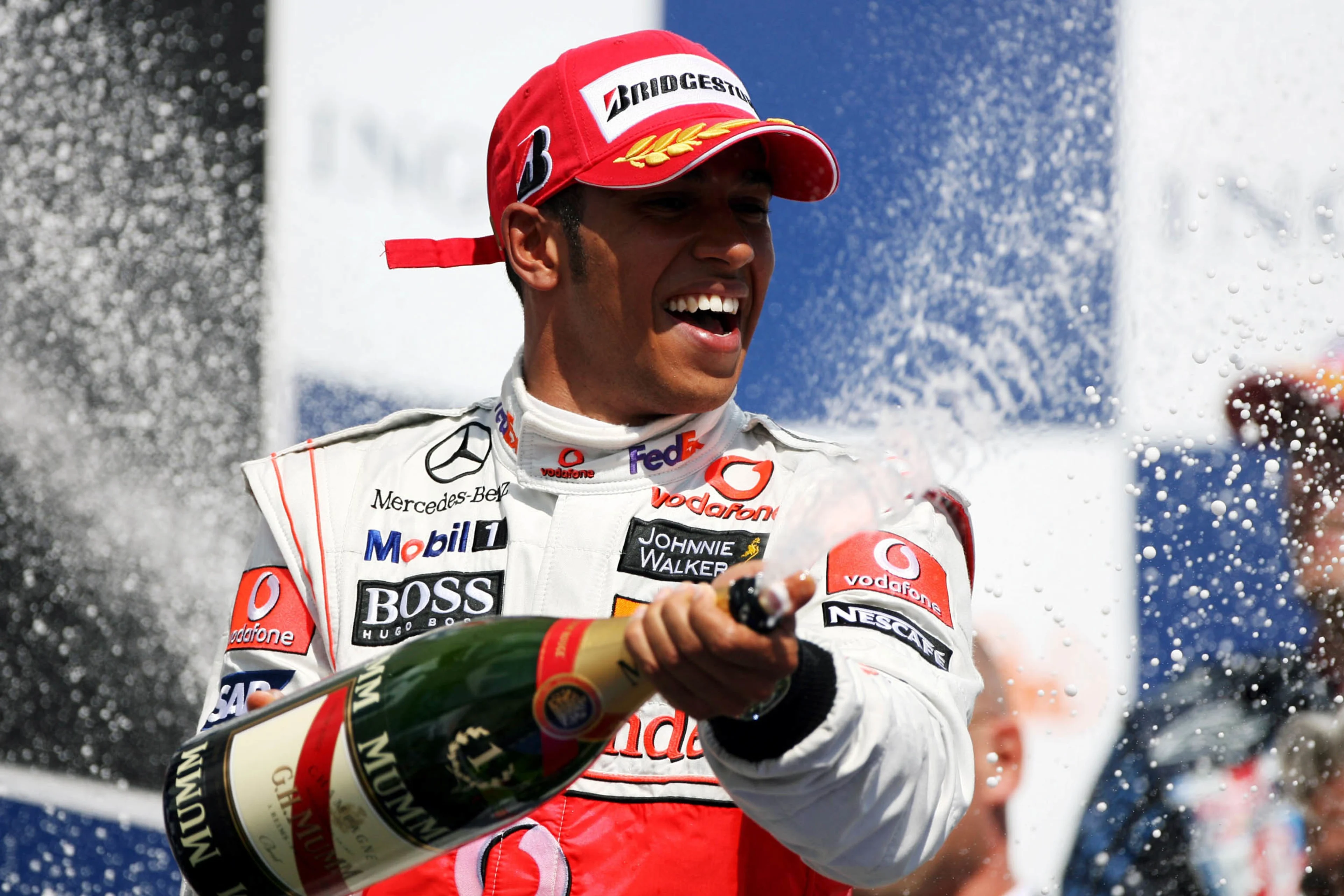
Nevertheless, the Brazilian triple champion had some crucial McLaren DNA in his blood.  After making his F1 debut at the wheel of an Ensign in the 1978 German GP, Nelson then switched to contest the next three races at the wheel of a McLaren M23 fielded by independents BS Fabrications.  So although Piquet never made it to the F1 front line at the wheel of a McLaren some of the key bedrock on which his brilliantly successful career was built had its direct bloodline extending back to the world championships won by Emerson Fittipaldi in 1974 and James Hunt in 1976.

On the strength of those McLaren outings in Austria, Holland and Italy, Nelson earned a drive with the Brabham-Alfa squad by the end of the year and joined Niki Lauda as a full time member of the Brabham team the following year. But when Lauda retired mid-way through 1979, Nelson was elevated to Brabham team leader. The following year he won his first Grand Prix victory through the streets of Long Beach and was only narrowly beaten to the title crown by Williams team leader Alan Jones.

Piquet remained with the Bernie Ecclestone-owned Brabham squad until the end of 1985 when we surprised the entire F1 fraternity by switching to the Williams-Honda team, winning his third world title with Frank’s team in 1987. He then made a strategic wrong-slot to join Lotus, but although he benefitted from the same Honda engines used by Ayrton Senna and Alain Prost at McLaren, the Lotus chassis was not in the same league as the McLaren and he had a fruitless year without a single victory. Between 1990 and 91 he enjoyed something of an Indian summer with Benetton which yielded three race wins and his F1 career eventually petered out at the end of this deal.


No. 41 Peter Gethin


b 21 February, 1940, Ewell, Surrey

30 Grands Prix, 1 win.  Career span: 1970-71 (McLaren); 1971-72 (BRM); 1974 (Hill)

The chirpy and popular pint-sized son of the successful jockey Ken Gethin scored his greatest F1 moment a matter of weeks after switching from McLaren to BRM in the summer of 1971 when he forced his BRM P160 through into the lead of the Italian GP at Monza, winning the race by one hundredth of a second at an average speed of 151.634mph. Not only was this the closest GP finish up to that point in history but also the fastest race average recorded.

Gethin started his professional career in junior league F3 in which he was a star during the mid-1960s.  On the strength of a string of consistently competitive performances, Gethin was recruited by Bruce McLaren to drive the works Church Farm Racing M10B in the inaugural UK domestic Formula 5000 championship in 1969, winning the title at his first attempt. 

The McLaren driver was locked in a season-long battle with Team Surtees works driver Trevor Taylor, with Peter just nudging ahead in the points stakes after the final round in which Taylor was eliminated lapping a slower car. For Gethin, this success was a worthwhile boost to his career, proving that he could handle a very powerful single-seater with some confidence as well as showcasing McLaren’s customer capability as F5000 continued to expand and grow on both sides of the Atlantic.

“Bruce had faith in me and I like to think I justified it during 1969,” said Gethin. “It also proved that there was another route which could lead you to F1 rather than simply F2 which was many people’s popular choice at the time.”

The following summer Gethin was testing the F1 McLaren M14 at Goodwood on the same day Bruce was killed in the latest Can-Am machine. The 30-year old Englishman stepped into the vacant McLaren F1 seat and also distinguished himself with the seriousness of purpose and discipline which he applied to handling the Can-Am M8F, which he did not allow to intimidate him.

“He did very much better than I ever expected him to,” said Teddy Mayer after Peter lucked into a Can-Am race win, although his place in the Can-Am line-up for 1971 was taken by Peter Revson and he was effectively bumped from the F1 squad mid-way through the year when Roger Penske did a deal for Mark Donohue to race a Mclaren M19A in the final two GPs of the year.

By then, of course, Gethin’s greatest day had come at Monza; but not at the wheel of a McLaren.

No. 42 David Hobbs

a.  9 June 1939, Leamington Spa, Warwickshire

7 Grands Prix, no wins

A likeable and enormously versatile driver, Hobbs could turn his hand to anything from F1 to sports cars and from touring cars to Indianapolis machines. He cut his racing teeth in the mid-sixties maelstrom of frenzied activity on the UK club racing scene, dabbling in Formula Junior, F2 and endurance racing in machines as diverse as the Team Surtees LoLa T70-Chevy GT and the JW Gulf Racing Ford GT40s.

In F1 he briefly tried his hand in privateer Bernard White’s 2-litre BRM P261 and also had an outing in one of the Honda V12s as a second entry alongside John Surtees. In 1971 he gained his first Championship success when he won the US Formula 5000 title at the wheel of a McLaren M10B-Chevy fielded by Cark Hogan’s  team. In 1971 he was invited to drive the works-prepared McLaren M19A fielded by the Penske team in the US GP at Watkins Glen where he finished a disappointing 10th one race after Mark Dononhue had driven it to third place in the Canadian race at Mosport Park.

Hobbs remained on the fringes of the McLaren family for a few more years yet. In  1974 got a couple of drives in the works Yardley McLaren M23 in the Austrian and Italian GPs. He had been drafted in to replace Mike Hailwood who had suffered serious leg injuries in a shunt during that year’s German GP at Nurburing, but Hobbs was frustrated in that the two tracks on which he was given this opportunity – Osterreichring and Monza – were both venues where he lacked recent experience.

“I was also frustrated by the fact that Henri Pescarolo, the French F1 driver, spent much of my Austrian GP practice session lurking in the back of the McLaren garage muttering ‘I am quicker than ‘Obbs’ which may well have been the case, although I was damned if I was going to give him the opportunity to demonstrate it,” he recalled many years later.

The 1974 season also saw Hobbs deliver his best result at the Indianapolis 500, driving a Carling Black Label-backed McLaren-Offenhauser to fifth place in the race which saw Johnny Rutherford score the first of his two works McLaren victories in the classic American event. Now retired, he has a prosperous car dealership near Milwaukee, Wisconsin, and has for many years made his home in the USA.


No. 43 Jackie Oliver

b 14 August 1942, Romford, Essex. 50 Grands Prix, no wins. Career span: 1967-68 (Lotus): 1969-70 (BRM); 1973 (Shadow): 1977 (Shadow)

Jackie Oliver’s three F1 outings for McLaren in the summer of 1971 kicked off on a most unfortunate note. Having qualified his M14A in 22nd position on the grid for the British GP at Silverstone, no sooner had Jackie dropped the clutch than he was confronted by the rear end of Graham Hill’s stationary Brabham BT34 six places in front of him. Oliver had nowhere to go apart from straight into the back of the veteran former twice world champion. Both were out of the race on the spot.

Oliver is a bright and breezy Essex lad who got a lucky career break, albeit in tragic circumstances, after the death of the legendary Jim Clark in April 1968. Drafted into the Lotus F1 team alongside Graham Hill, he immediately blotted his copybook with Lotus boss Colin Chapman by shunting his Lotus 49B at both Monaco and Rouen, but was commandingly leading the British GP at Brands Hatch when his car’s transmission failed.

“I started my F1 career with probably the best F1 car of its time with Lotus 49,” he recalled. “I went to BRM in probably the worst in 1969, and although better in 1970 it never got to the end of any of the races. I moved to McLaren in 71, and the car was probably the worst from the team anyone could have contested in before or since.”

As Jackie points out, it wasn’t simply a question of the M14A being somewhat less than competitive – and the first M19 not being much better.

“The few races I did for them were marred by incidents, most of which I try to forget. Nowhere to go with Graham's Brabham at the start line incident at Silverstone, retainer plates being improperly fitted to the inboard rear brake callipers at the Austrian GP, launching the four pads out through the rear wing on its first brake application and me and the car on into the barrier. Finally a rear Goodyear tyre came off the rim at maximum speed during the Italian GP at Monza. This was before tyre pegs being fitted to cross-ply construction tyres.”

For 1969 Oliver had been replaced at Lotus by Jochen Rindt, moving on to the BRM squad on a two-year contract which only really paid off in 1970 when the team’s new Tony Southgate-designed P153 proved competitive in terms of pace, but sadly not so in reliability. He then had his three race odyssey with McLaren in 1971 after which his only F1 outing was a guest drive for BRM in the following year’s British GP at Brands Hatch until he rejoined the world championship trail on a full-time basis with the emergent Arrows team in 1973.
Oliver retired from driving in F1 at the end of 1973, although he won the Can-Am sports car championship the following year, after which he moved into a management role at Shadow. In 1978 he and a group of fellow Shadow employees left to set up the new Arrows F1 squad which he subsequently sold to the late Tom Walkinshaw. For nine years he was a director of the British Racing Drivers’ Club, the owner of Silverstone and is still involved in the circuit as a non-executive director.


No. 44 Chris Amon (NZ)

b. 20 July, 1943, Bulls, North Island

96 Grands Prix, no wins.

Career span: 1963 (Lola and Lotus); 1964-65 (Lotus); 1966 (Cooper); 1967-69 (Ferrari); 1970 (March); 1971-72 (Matra); 1973 (Tecno); 1974 (Amon and BRM); 1975-76 (Ensign).

When Bruce McLaren was laying his company’s original plans for an F1 bid in 1966 it was originally intended that the team should field not one but two M2Bs in each round of the World Championship. One was to be driven by Bruce, the other by a mild-mannered and boyish young Kiwi named Chris Amon, one of the most talented racing drivers to emerge from that country. And without doubt the unluckiest.

The power unit for the M2B was to be a reduced capacity 3-litre version of the 4.2-litre Ford V8 stock block Indy engine, but it soon became clear that taking on an engine development programme at the same time as they were building a new F1 machine meant that McLaren had bitten off more than it could chew. Such was the pressure on their technical resources that mostly there was just a single car fielded for Bruce and it was usually a scramble to get that ready while Amon was left to twiddle his thumbs.

Even by this early stage in his career, Chris was rightly hailed as a really top line driver, although his unerring ability to be in the wrong place at the wrong moment would bug his progress to the end. His pace in the Group 7 McLaren-Ford sports cars was prodigious, but his move to Ferrari at the start of 1967 precluded him from tapping into the seam of gold that was McLaren’s five year domination of the emergent Can-Am series. Later, a return to Bruce’s squad for a planned Indy 500 programme in 1970 fell apart when Chris felt spooked by the proximity of the Brickyard’s unyielding outer wall and he decided to give the race a miss.

During Chris’s three seasons with Ferrari, he could never quite nail down that elusive Grand Prix win. Throughout his career he started no fewer than 19 times from the front row of the grid, but close second places in the 1968 British GP (for Ferrari) and a similar result for March in Belgium two years later was as good as it got. His only wins came in non-title races, the 1970 Silverstone International Trophy and the 1971 Argentine Grand Prix, but he  consistenly failed to parlay these secondary triumphs into front line success.

After switching to the French Matra team at the end of 1970 he would dominate the 1972 French GP at Clermont-Ferrand, leaving his rivals in the dust as he stormed away from the field. Then a puncture intervened, he pitted for fresh tyres – and finished third.

On a more positive not, Chris and Bruce McLaren won the 1966 Le Mans 24-hour sports car classic in a 7-litre Ford V8. If Chris had stayed closer to Bruce for longer, the story might have been oh-so-different.

No. 45.  John Surtees (GB)

b, 11 February, 1934, Tatsfield, Surrey.

111 Grands Prix; 6 wins; World Champion 1964. Career span: 1960 (Lotus); 1961 (Cooper); 1962 (Lola); 1963-66 (Ferrari); 1966 (Cooper); 1967-68 (Honda); 1969 (BRM); 1970 (McLaren); 1970-72 (Surtees)

The name of John Surtees is not usually – or immediately – linked to the F1 history of McLaren and indeed many fans will remember him as one of the marque’s greatest rivals in the mid-1960s when his Team Surtees Lola T70 Group 7 sports cars squared up to Bruce and Chris Amon in ‘big banger’ sports car racing on both sides of the Atlantic.

Eventually Surtees set out to establish his team as an F1 constructor at the start of the 1970 season, but since it took much longer than expected to ready the first Surtees TS7 chassis, John invested in an ex-works McLaren M7C chassis which he gave a debut outing in the season-opening South African GP at Kyalami. He retired with engine failure after an impressively strong run, but this was generally a disappointing dalliance for Surtees. The M7C retired with a throttle problem in the Brands Hatch Race of Champions and then the gearbox broke in the SpanIsh GP at Jarama.

The trend continued depressingly through to the middle of the year when the TS7 made its debut in the British GP at Brands Hatch and all his efforts were concentrated on this new project from then on. It made many people wonder just how different things might have been had Surtees abandoned his obsession to engineer his own cars and simply thrown in his lot with a team like McLaren in order to concentrate on what he did best. Driving.

A deeply committed and very serious minded competitor, John Surtees moved into car racing after a glittering career on two wheels. The son of a well-known pre and post-war competitor and garage owner, Jack Surtees, John served an apprenticeship with Vincent-HRD at Stevenage before embarking on an international career which would yield seven motorcycle world championships for the Gallarete-based MV Agusta team. Having been invited to test an Aston Martin DBR1 sports car and a Vanwall Grand Prix machine at the end of 1959, Surtees made his car racing debut in a Formula Junior Cooper the following year largely because of Agusta’s reluctance to make available to John bikes on which he could contest some of the British domestic events.

The 1960 season also saw him make his F1 debut for Colin Chapman’s Team Lotus, posting a brilliant second place finish in the British GP. For 1961 he made the tactical mistake of switching to the Yeoman Credit Cooper team instead of accepting an offer from Chapman to line up as Jim Clark’s team-mate. It was a decision which set back Surtees’s F1 career by a couple of seasons and he really only got back on track with competitive machinery when he joined Ferrari at the start of 1963.

Surtees won the F1 world championship in 1964, remaining to this day the only competitor to take top honours in both these disciplines. But when he quit Ferrari, after a spat with team manager Eugenio Dragoni just before the 1966 Le Mans 24-hour classic, with hindsight it may be that he made the wrong decision. His star never shone as brightly again right through to his retirement from driving in 1972. I wonder what would have happened if John Surtees had become a works McLaren F1 driver.


No. 46.  Derek Bell  (GB)

Born  31 October, 1941.

9 Grands Prix, no wins. Career span: 1968-69 (Ferrari and McLaren); 1970 (Brabham and Surtees); 1971 (Surtees); 1972 (Tecno); 1974 (Surtees)

Derek has always been an immensely popular personality on the international motor racing scene, but his F1 association with the works McLaren team amounted to just a single outing at the wheel of the unloved four-wheel-drive M9 in the 1969 British GP at Silverstone.

A graduate of the rough-and-tumble of 1-litre Formula 3 during the mind-1960s, Derek moved up into F2 for the 1968 season driving a Brabham BT23C fielded by his family’s Church Farm Racing team from Sussex.  Some initially promisining drives earned him an offer from Ferrari to race first in F2, and later that same season, in F1.  Not many British drivers can claim to have made their F1 world championship debut in the Italian GP at Monza, but that’s what Bell did in 1968.  Disappointingly, he caught Maranello on something of a downswing and was out of a drive by the start of the following season.

The outing at Silverstone in the McLaren M9 proved a waste of time for all concerned.  Bell retired after a handful of laps and McLaren scrapped any further development plans it might have had for the project.  Yet that would not be the end of Derek’s association with McLaren. In 1971 he would have several races in a M8F fielded by privateer Sid Taylor in rounds of the Interserie championship – an effort to bring Can-Am style sports car racing to Europe – and then in 1995 he finished third at Le Mans sharing the Dave Price-prepared Harrods McLaren F1-GTR with his son Justin and Andy Wallace.

Remembers Derek: “There was a slight shadow on the horizon even before the race began as McLaren advised its customers that there was a beneficial piece of optional equipment available to make sure the cars would last the 24-hour grind with no problems. This was an upgraded specification heavy duty gearbox. McLaren recommended that if its customers wanted to be sure of tackling Le Mans successfully then they would find this investment worthwhile.

“Yet we looked strong from the start. About three hours into the contest it began to rain which helped us by taking some of the strain off our ‘standard’ gearbox. I had done the start and after my opening stint I handed over to my son Justin who, much too soon, suddenly appeared in the team caravan with his eyes looking like poached eggs after spinning in the wet during the night, while Andy called in to say that he couldn’t concentrate any longer.

“The conditions had completely spooked them both and I immediately took over. There I was with two young stars and I was the last man standing.

“On Sunday morning I found myself embroiled in an epic battle with J.J. Lehto in the Paul Lanzante-prepared F1 GTR which eventually won the race. At the start of our stint he was 25sec behind me and, being an established top driver of the moment against me in my fifties, it looked as though he wanted to see the Old Man thrashed. I just ignored my mirrors, got my head down and during that stint pulled out another seven seconds on J.J. which was immensely satisfying. Later the conditions dried out and we had to take it easy with the car’s transmission, finishing third.  And I came back the following year to finish sixth with Olivier Grouillard and Andy Wallace again!”

No. 47: Andrea de Cesaris

b. 31 May 1959, Rome.

208 Grands Prix, no wins.  Career span: 1980 (Alfa Romeo); 1981 (McLaren); 1982-83 (Alfa Romeo); 1984-85 (Ligier); 1986 (Minardi); 1987 (Brabham); 1988 (Rial); 1989-90 (Dallara); 1991 (Jordan); 1992-93 (Tyrrell); 1994 (Jordan and Sauber).

The 1981 British Grand Prix at Silverstone will be well-recalled in the annals of McLaren F1 history for delivering the maiden victory of the new carbon-fibre chassis MP4 thanks to the efforts of John Watson. However the team’s second MP4, driven by Andrea de Cesaris, spent most of the race embedded in the catch fencing at Woodcote corner where it had been unceremoniously dumped by the young Italian at the end of the race’s opening lap.

In essence, that episode encapsulated Andrea’s single season as a McLaren driver and only his second as an F1 competitor.  “Now Andrea, whatever you do, keep well away from John’s car in the opening stages,” Ron Dennis told de Cesaris just before he took his place on the starting grid. It’s tempting to think that Ron suspected just what might be about to happen and was seeking to calm his young recruit’s enthusiasm.

His words had scant effect. Coming through the Woodcote chicane at the end of the first laps, Gilles Villeneuve’s Ferrari turbo was pitched into a spin over the high kerbing and collected Alan Jones’s pursuing Williams. Next up in the queue was Watson, who braked hard and successfully to avoid the chaos unfolding in front of him. Andrea, tucked right under the rear wing literally inches from the back of Watson’s car in stark contravention of Mr Dennis’s instructions, could do nothing but stamp hard on the brakes – and pirouetted out of the contest at high speed.

The Italian driver’s career was characterised throughout by a nervous facial twitch which suffused his rivals with nervous apprehension. Some days de Cesaris would drive with exemplary assurance and control, but for most of the time he displayed an erratic over-aggression which looked worrying at best.

De Cesaris is an undeniably pleasant character. But he was sustained in his F1 career largely through his family’s business contacts with Philip Morris who helped arrange his F1 debut at the wheel of an Alfa Romeo in 1980 before switching him to McLaren in 1981. Unfortunately his season at McLaren was marred by more than a handful of silly accidents, so there was no way Ron was going to keep him for a second year when Niki Lauda was available for a comeback.

De Cesaris switched back to Alfa in 1982 for two seasons scoring his best results with second places in the 1983 German and South African GPs. Then it was off to Ligier, Minardi, Bernie Ecclestone’s Brabham squad, Dallara, Jordan, Tyrrell and Sauber in unproductively quick succession. It’s tempting to say that Andrea de Cesaris enjoyed his F1 career, but with just a single pole position set against a total of 39 accidents which saw him off the road with a damaged car you might be forgiven for reaching a very different conclusion!

No.48: Nigel Mansell

b. 8 August 1953, Upton-on-Severn, UK

187 Grands Prix, 31 wins. World Champion 1992 (Williams).  Career span: 1980-84 (Lotus); 1985-88, 1991-92 and 1994 (Williams); 1989-1990 (Ferrari); 1993-1994 (Newman/Haas [CART Champion]); 1995 (McLaren).

I can hear the strangulated howls of indignation as I write these very words. Mansell! 48?! Let’s make it clear: Nigel Mansell was an explosively talented driver, but his legendary record of achievement was carved out during his two stints with Williams and one with Ferrari. And in the end this list is about drivers’ contributions to the McLaren team. Even before he lined up on a starting grid for the first of his two races at the wheel of a McLaren-Mercedes MP4-10 at the start of the 1995 season it already looked as though his relationship with the Woking brigade was doomed.

Circumstances conspired to make Mansell’s brief tenure at McLaren no more of a success than Michael Andretti’s, proving yet again that timing is everything in life. Arriving in the McLaren fold off the back of a season-ending win for Williams, in the 1994 Australian GP at AdelaIde, created a keen sense of anticipation which was always going to be difficult to reconcile with reality.

Mansell had been used to a tough time as he climbed the F1 ladder. A protege of Lotus founder Colin Chapman he impressed greatly during his first F1 test in the summer of 1979. By the following summer he was making his GP debut alongside MarIo Andretti and Elio de Angelis in a third Lotus 81 at the Osterreichring, gaining full-time promotion to the Lotus team the following year. He quickly demonstrated he had the tenacity and speed to get the job done, but until he switched to Williams in 1985 he could not find the magic key to transform himself into a winner.

In 1986, driving the Honda-engined Williams FW11, Mansell was seemingly on his way to the world championship title when he suffered a 200mph rear tyre failure in the Australian GP.  It would take him another six years, interspersed with a spell at Ferrari, before he got back behind the wheel of another Williams capable of carrying him to the title crown.

Angered by Frank Williams’s insistence that he would sign up Alain Prost as his team-mate for 1992, Nigel turned his back on F1. Instead, he signed for the Newman Haas Indycar team, winning the American championship at his first attempt and very nearly winning the Indianapolis 500 in the process. The tragic death of Ayrton Senna in the 1994 San Marino GP at Imola propelled Mansell back into the F1 orbit as a part-time replacement for the legendary Brazilian. But when Williams decided to retain Damon Hill and David Coulthard for 1995 the offer from McLaren looked as though it had come at just the right moment.

Yet the MP4-10 was a not a great car and, to heighten the frustration, Mansell’s hips were too wide for the cockpit and a brand new monocoque had to be made, forcing the team to sign Mark Blundell as a stand-in for the former world champion in the first two races.  Mansell then suffered a puncture at Imola and pulled into the pit lane after a few laps at Barcelona.  It was the end of a fraught and disappointing story.

No.49: Michael Andretti (USA)

b. 5 October 1962, Bethlehem, Pennsylvania. 13 Grands Prix, 0 wins. Career span: 1993 (McLaren)

It seemed as though Michael Andretti had all the credentials to lay claim to a significant F1 career, but this son of the 1978 world champion Mario Andretti saw his world championship hopes thwarted by the unfortunate timing of his move into the sport’s most senior category. For 1993 McLaren signed up Michael to partner Ayrton Senna in the Cosworth V8-engined MP4/8s and, when the deal was announced at Monza over the weekend of the 1992 Italian GP, most observers nodded approvingly.  Only when things went wrong did the critics emerge with that priceless of all commodities, hindsight.

His father’s running mate in the pace-setting Newman-Haas Lola Indycar team for the previous three seasons, Michael had been acknowledged as one of the most naturally talented and motivated drivers to have emerged from the Indycar series over the previous decade. Since his debut in that category in 1984 he had won 27 races and scored an equal number of pole position starts. In 1992 he had led the Indy 500 for 161 of its 200 laps before mechanical failure intervened.

“I think he can win Grands Prix and become the world champion,” said Ron Dennis. “It’s not a question of which country you come from. It’s how you demonstrate your desire to win.” That was as maybe, but there were practical factors that mitigated against Andretti being able to show competitive form in his crucial freshman year in F1. Rule changes destroyed Michael’s hopes of unrestricted laps in free practice during which he could learn circuits which were unfamiliar to him. From the start of 1993 there were just 23 laps allowed in the morning’s untimed session and a mere 12 in the qualifying session.

With the pressure intensifying, Andretti began the season with crashes at Kyalami and Interlagos. He then qualified a fine sixth for the European GP at Donington Park – a whisker behind Senna who would win the race – but he collided with Karl Wendlinger’s Sauber on the opening lap. At Imola he again fell foul of the Sauber driver after a zestful drive which might have ended with a podium finish, and many people cited this as the key turning point of the pleasant American’s year.

Andretti scored points on only three occasions, but he could never quite string things together consistently. Despite the unflinching support offered by the McLaren management, the season proved to be a disaster for the unseasoned new boy. True enough, he finished third at Monza, but with three races still to go the whole deal with Andretti was quietly wrapped up and his place in the team taken by test driver Mika Hakkinen. It reminded people just what they had been missing.

No.50: Philippe Alliot

b. 27 July 1954, Voves. 109 Grands Prix, 0 wins. Career span: 1984-85 (RAM); 1987-89 (Larrousse Lola); 1990 and 93 (Ligier); 1994 (McLaren and Larrousse)

Alliot was forced into the F1 front line with McLaren through circumstances beyond his control so it would obviously have been unreasonable to have expected too much of him on what amounted to a single guest outing with the team.

The pleasant Frenchman drove just a single race in the 1994 McLaren-Peugeot MP4/9 at that year’s Hungarian GP after Mika Hakkinen was given a one race suspension for triggering a first corner multiple collision during the previous race at Hockenheim.

Alliot was an admittedly genial personality, but imbued with an over-enthusiastic streak which drove F1 team boss Guy Ligier to distraction during his last full F1 season when he set an unofficial record for crashing, damaging to varying degrees more than a dozen chassis during the course of the year. Apart from two guest drives in 1994 – one for McLaren, the other for Larrousse – this brought an end to Alliot’s Grand Prix ambitions which had started at the Nogaro driving school in 1975 and yielded considerable success in F3 as well as a third place at Le Mans with a Porsche 956 in 1983, sharing with Mario and Michael  Andretti.

After two years in F1 with the miserably uncompetitive Hart-engined RAMs, Alliot dropped back into Formula 3000 but gained restoration to F1 with the Ligier team following Jacques Laffite’s serious accident at Brands Hatch in 1986. For the next three seasons he drove for Gerard Larrousse and then returned to Ligier for a less-than-spectacular finale.

Alliot was also unquestionably well connected.  One of his big pals was Jean-Pierre Jabouille, the former Renault F1 driver who subsequently became boss of the Peugeot competition effort.

During early 1994, Jabouille tried to use all his influence to see Alliot replace Martin Brundle in the McLaren line-up alongside Hakkinen.  A test was arranged at Paul Ricard and the main straight was "slowed" with a straw bale chicane. After Martin's run, Alliot took over and initially was slower, however he then produced a much quicker lap time. Jabouille was very pleased to have proven his point, until one of the McLaren engineers pointed out that Alliot had suddenly gone quickly through the chicane without lifting or importantly showing any lateral "g-forces". Whether Alliot's friends had moved the straw bales or whether he and found a way around the edge, nobody ever found out.

Either way, when he went up against Brundle at the Hungaroring, Martin lined up 6th on the grid, the Frenchman 14th.  Martin kept his drive!

Back to top>

No 9 :: Peter Revson

No 9 :: Peter Revson

No 10 :: John Watson

No 10 :: John Watson

No 11 :: Denny Hulme (left)

No 11 :: Denny Hulme (left)

No 12 :: Johnny Rutherford

No 12 :: Johnny Rutherford

No 13 :: Dan Gurney

No 13 :: Dan Gurney

No 14 :: Gerhard Berger

No 14 :: Gerhard Berger

No 15 :: Kimi Räikkönen

No 15 :: Kimi Räikkönen

No 16 :: Mark Donohue (right)

No 16 :: Mark Donohue (right)

No 17 :: Juan Pablo Montoya

No 17 :: Juan Pablo Montoya

No 18 :: Jody Scheckter

No 18 :: Jody Scheckter

No 19 :: Stefan Johansson

No 19 :: Stefan Johansson

No 20 :: Martin Brundle

No 20 :: Martin Brundle

No 21 :: Gilles Villeneuve

No 21 :: Gilles Villeneuve

No 22 :: Jochen Mass

No 22 :: Jochen Mass

No 23 :: Mike Hailwood

No 23 :: Mike Hailwood

No 24 :: Patrick Tambay

No 24 :: Patrick Tambay

No 25 :: Mark Blundell

No 25 :: Mark Blundell

No 26 :: Brian Redman (left)

No 26 :: Brian Redman (left)

No 27 :: Alexander Wurz

No 27 :: Alexander Wurz

No 28 :: Tim Mayer

No 28 :: Tim Mayer

No 29 :: Jacky Ickx

No 29 :: Jacky Ickx

No 30 :: Vic Elford

No 30 :: Vic Elford

No 31 :: Jo Bonnier

No 31 :: Jo Bonnier

No 32 :: Andrea de Adamich

No 32 :: Andrea de Adamich

No 33 :: Brett Lunger

No 33 :: Brett Lunger

No 34 :: J.J. Lehto

No 34 :: J.J. Lehto

No.35 :: Yannick Dalmas

No.35 :: Yannick Dalmas

No.36 :: Bruno Giacomelli

No.36 :: Bruno Giacomelli

No.37 :: Masanori Sekiya

No.37 :: Masanori Sekiya

No.38 :: John Cannon

No.38 :: John Cannon

No.39 :: Carlos Reutemann

No.39 :: Carlos Reutemann

No.40 :: Nelson Piquet

No.40 :: Nelson Piquet

No.41 :: Peter Gethin

No.41 :: Peter Gethin

No.42 :: David Hobbs

No.42 :: David Hobbs

No.43 :: Jackie Oliver

No.43 :: Jackie Oliver

No.44 :: Chris Amon

No.44 :: Chris Amon

No.45 :: John Surtees

No.45 :: John Surtees

No.46 :: Derek Bell (GB)

No.46 :: Derek Bell (GB)

No.47 :: Andrea De Cesaris

No.47 :: Andrea De Cesaris

No.48 :: Nigel Mansell

No.48 :: Nigel Mansell

No.49 :: Michael Andretti (USA)

No.49 :: Michael Andretti (USA)

No.50 :: Philippe Alliot

No.50 :: Philippe Alliot