




McLaren LIVE is a unique and immersive in-browser app that live-streams telemetry, timing information and radio conversations to your desktop, tablet or mobile – all for free.
It updates continuously during every practice, qualifying and race session, allowing you to analyse incredibly detailed channels of data from both Jenson and Checo’s car. It also provides privileged access into the chatter and flow of the pit garage, bringing you insight and information that are simply not available on television.

Members
Team McLaren is the Official home for fans of Vodafone McLaren Mercedes. Being part of Team McLaren brings you closer to the action, gives you access to exclusive experiences and features, including our latest fan competitions and fantastic Grand Prix wallpapers.

Get even more by purchasing an Annual Membership, including an exclusive members pack, access to priceless events & experiences, discounts on Vodafone McLaren Mercedes merchandise in the official McLaren Store, and much more.
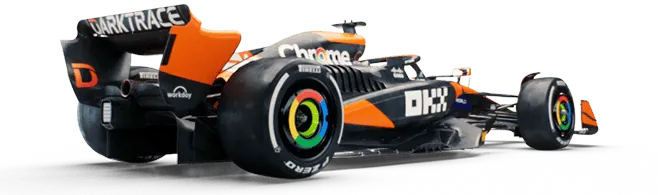
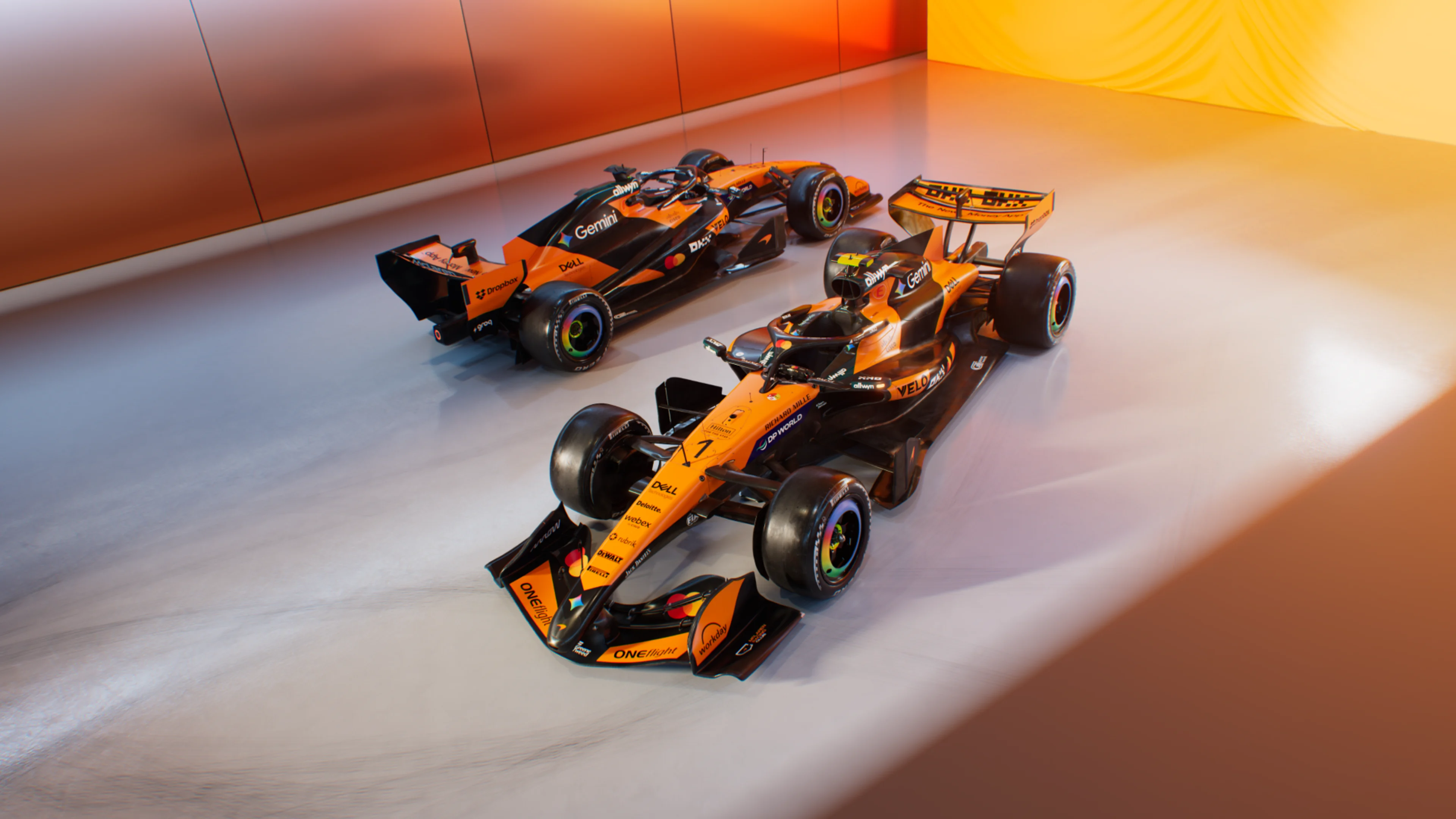
A Formula 1 car is a high-speed prototype. It is constantly evolving, developing, losing weight, gaining speed. At Vodafone McLaren Mercedes, we’ll never race the same-spec car twice – in fact, the rate of development is so intense that we introduce a new part to the F1 car on average every 17 minutes.
Design is an iterative process: the grand prix car introduced at the start of a new Formula 1 season benefits from the collective experience of the previous season’s successes and failures. It is developed on the computer screen, in the windtunnel and, finally, on the racetrack – the truest test of performance and potential. Built from carbon-fibre, the best Formula 1 cars will harness every available surface of the car to create downwards lift (‘downforce’), maximising the grip of the tyres through corners while simultaneously minimising drag. The MP4-28, the result of thousands of man- and computer-hours of diligent hard work, would look no less out of place on the couture runway than on the racetrack: it is a thing of complete, functional, raw beauty.
The airflow collected by the front wing influences the critical aerodynamic flow over the rest of the entire car. Most critically, the front wing most directly influences the grip and effectiveness of the front tyres – raising the front-wing angle increases the downforce that affects the front wheels, creating a grippier front-end (oversteer); lowering the front-wing has the reverse effect (understeer). During practice, the driver and his engineers will work to find the perfect front-wing balance – trading off front-end grip against excessive, and debilitating, tyrewear and extra aerodynamic drag. During races, team mechanics can adjust the front-wing to influence handling during the pitstops.
Tyres
Tyre performance is one of the biggest performance differentiators in Formula 1; a car that uses its tyres well can find potentially huge performance advantages. Establishing and maintaining tyre temperature is critical, and requires skillful driver input and feedback, as well as the correct selection of tyre for the conditions. As a tyre grows older, its performance gradually degrades until it’s no longer competitive – at which point, drivers head to the pits to fit fresh rubber. Therefore, it’s essential that both the engineers and the drivers work to ease the degradation as much as possible. Additionally, tyre supply is limited, making tyre preservation a particularly prized asset among drivers.
2013 tyre rules
For 2013, official tyre supplier Pirelli will provide only six Prime (harder) and Option (softer) dry-weather tyres to each driver at every race weekend. At each race, Pirelli chooses two from a possible four compounds to best suit the track and its conditions. The dry-weather tyre compounds are graded in order of durability, with markings on the sidewalls as follows: Hard (silver), Medium (white), Soft (yellow), Supersoft (red). Teams must race both compounds to be eligible to score points. In a wet race, however, a further two compounds are introduced: Full Wet (blue) and Intermediate (green) – these are heavily treaded to cope with the rain and standing water on the track, but can degrade quickly as the circuit dries out. In a wet-dry race, tyre management can be the crucial differentiator between defeat and victory.
Survival Cell
The cockpit survival cell is a near-impregnable protective cocoon that safely houses the driver and the fuel cell. While a grand prix car will shed components during a heavy crash in order to absorb impact energies, the survival cell typically emerges fully intact, with the driver cushioned from the heaviest g-forces by the provision of crushable impact structures and a padded cockpit surround. The cell is constructed from multiple layers of carbon-fibre – a lightweight and incredibly stiff material that can be layered to withstand huge forces. In 1981, McLaren became the first team in Formula 1 to race a carbon-fibre survival cell – they are now commonplace throughout all categories of motorsport.
Engine & KERS Hybrid
Our car uses Mercedes-Benz’s state of the art FO 108F engine – it’s a 2.4-litre V8, so similar in capacity to the unit in a family car, but tuned to rev to a huge 18,000rpm and deliver a mighty 750bhp. From a standing start, it can hit 100km/h in 2.5s; and will hit 200km/h in 5s…
Engine use is strictly regulated: the F1 technical rules state that each driver may only use eight engines per season – any more and he will be awarded a 10-place grid penalty for each additional change.
In addition, our engines utilise a kinetic energy recovery system – a hybrid motor that’s charged using the heat energy created under braking. At the push of a button on the steering wheel, Jenson or Checo can summon a further 60kW of recovered energy to assist with overtaking or defending. Strategic deployment of KERS has become a strategic tool for every driver – it can benefit laptime by as much as 0.4s.
Gearbox
The MP4-28's gearbox is not only designed to handle the huge internal stresses of an engine revving to 18,000rpm, but also to operate seamlessly between shifts to ensure minimal loss in momentum (seamless shift was pioneered by McLaren back in 2005), and to last for five consecutive race weekends – a cost-saving regulation which costs drivers five grid positions for each premature change. Our gearboxes are made from carbon-fibre and run seven forward and one reverse gear – all lubricated by Mobil 1’s fantastic SHC™ gear oils.
Rear Wing / DRS
The MP4-28’s huge rear wing harnesses the massively powerful airflow that streams across the top bodywork, using it to nail the rear of the car more effectively to the track surface. However, the rear wing also creates considerable drag – inefficient aero impedance – so it’s common for teams to run more modest wings at circuits where grip is less important than flat-out speed (such as Montreal or Monza).
Additionally, modern F1 cars also have a drag reduction system (DRS) built into the rear wing. The DRS is a switchable wing flap, controlled by the driver, which creates a small straight-line speed boost to aid overtaking. During races, a driver can only deploy the wing in a permitted DRS zone if he is less than one second behind the car he is following.
This module requires Unity 3D. You can download the plugin here.
Aerodynamics
A Formula 1 car is cloaked with tightly hugging streamlined panels in order to optimise the critical airflow above and below the chassis. Bodywork is developed by computer and tested in our windtunnel to ensure it's as smooth and slippery as possible when the car is out on the track. Inefficient bodywork causes excess drag, which slows the car down.
For our designers, the key is to package the car’s internals as tightly as possible – while still ensuring they won’t overheat at the calendar’s hottest races! – in order to minimise the car’s aero silhouette. Clever bodywork detailing can create 'downforce' – airflow that increases grip by pushing the car harder to the ground.
~1.3%
Steering
20 Functions, 1 Wheel
The steering wheel is the driver's office; to hand it contains access to every part of functionality and control required for a grand prix race. Every toggle, switch and lever is placed in a considered position and has a key purpose.
McLaren-moulded carbonfibre composite incorporating front and side impact structures, and survival cell
Front suspension
Inboard torsion bar/damper system operated by pullrod and bell crank with a double wishbone arrangement
Rear suspension
Inboard torsion bar/damper system operated by pullrod and bell crank with a double wishbone arrangement
Electronics
McLaren Electronic Systems. Including chassis control, engine control, data acquisition, dashboard, alternator, sensors, data analysis and telemetry.
Bodywork
Carbon-fibre composite. Including engine cover, sidepods, floor, nose, front wing and rear wing. Driver-operated drag reduction system
Lubricants & Fluids
Mobilith SHC™ 1500 Grease – lubricates the four tripod joints on the drive-shafts resisting the high temperatures generated by the exhaust and braking systems
Mobilith SHC™ 220 Grease – minimises rolling resistance in the car's ceramic wheel bearings to help maximise speed.
Mobil SHC™ Hydraulic Oil – running at over 200 bar and 100° C this fluid is an essential part of the hydraulic system which controls gear shift, the throttles and operation of DRS and steering systems
');
var F1 = F1 || {};
F1.pathToUnity = "http://f2ea79120e0c5e59eaa8-aaf3fd1c2e610a1f32e9828963e880b8.r76.cf3.rackcdn.com/unity/MP428_cleanwhite.unity3d";
-->